![]() |
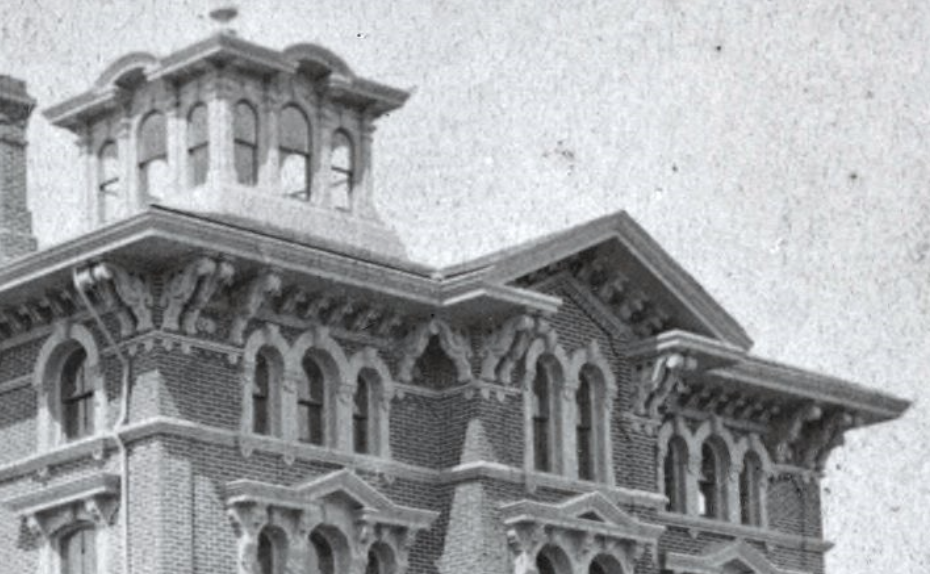
| Miller House, Lewisburg, PA. 1860s All Photos: Lewisburg Architecture Project |
A blog devoted to American Italianate architecture of the 19th century. This blog features architectural analyses of Italianate domestic buildings with images, and historical information. My plan is to show the varieties, regional vernacular of Italianate architecture.
Showing posts with label triple arched palladian. Show all posts
Saturday, April 6, 2019
The Daniel Bright Miller House, Lewisburg, PA
Wednesday, April 3, 2019
The James S. Marsh House, Lewisburg, PA
![]() | |||
| The James S. Marsh House, Lewisburg, PA. 1860s Photo: Joseph a |
It is a tour de force of Italianate design and includes all sorts of bells and whistles. It is a symmetrical five bay house with a gable roof and, unusually, a cupola. Usually cupolas are placed on hip roofs and not gabled roofs. On the first floor, the house has segmental arched windows and on the second and third round arched windows. All have a similar drip molding that conforms to the arch shape and ends in Gothic style finials and almost all have Venetian tracery. In the center is a triple arched palladian window, also with a conforming molding. The designer even put grand windows in the attic story at the end, a rather expensive decision. The finish is stucco with impressive quoins at the corners and a rusticated basement. The front looks a little bare. It's likely that it had an entrance porch that matched the side porch, a rather rich design with a fringe, s and c scroll brackets, and arches interrupted by carved keystones and a wooden fringe. The cornice is the fillet cornice type with a deep architrave and filleted panels alternating with filleted windows topped by a run of fringe made by pieces of wooden molding. The brackets are s scroll type and the sides form curved rinceaux. Particularly lavish is the cupola with wood rusticated to look like masonry. The backets and two windows match the facade windows with Venetian tracery and strong moldings with added multi eared surrounds. A different cornice type, the undulating cornice was used here. An earlier view of the house shows a grand balustrade on the cupola and a balustrade atop both porches. These things always rot off.
Sunday, April 8, 2018
The Thomas E. Powell House, Columbus, OH
The Thomas E. Powell House, Columbus, OH. 1853
Both Photos Columbus Illustrated and History of Columbus
|
Although not part of E Town Street, but part of the E Broad Street area, another mansions street in its own right, I couldn't resist this rather bizarre Italianate of 1853. The house is a symmetrical plan Italianate with a brick façade, and it's in this paneled brick style that it is most distinctive. The house is divided by its brickwork into three bays by pilasters topped with moldings. The side bays enclose double windows with filleted corners, while the central bay has a rectangular triple window with narrow side lights. The lintels above seem to be stone with incised designs, eared, rising to a shallow point. But the entablature is truly strange, comprising on the side bays three evenly spaced segmental arches with some kind of projecting finials and panels that match the curve of the arches. In the central bay, there is a more elaborately framed trefoil curve that suggests a triple arched Palladian design, but it is strange that that is not reflected in the window. The porch similarly has this trefoil shape, albeit with open spandrels, resting on thin columns. I can't actually tell the forms of the brackets from the images. The cupola seems almost oversize for the house, with curved frames around the tombstone windows and a balustrade above. The Midwest liked its fancy brickwork, but this is a very odd design. The house was torn down in 1928.
Monday, February 26, 2018
'Evergreen on the Falls' the Albert H. Carroll House, Baltimore, MD
![]() |
| The Albert H. Caroll House, Baltimore, MD. 1860 Photo: Wikimedia |
Thursday, February 8, 2018
The Clark J. Whitney House, Detroit MI
![]() |
| The Clark J. Whitney House, Detroit MI. 1857 Photo: Scott Weir |
![]() |
| The same house in 1882. Photo: Scott Weir |
It's rare to see an Italianate remodeled into another Italianate. Typically you slap a mansard roof on top or a Queen Anne gable and call it a day. But that's not what Whitney did with his chaste 1857 house in Detroit. Instead, he took his genteel Italianate and decided to display his new status with a zany new design, doubling the size and basically constructing a new house right into the fabric of the old. The house has a rotated side tower plan. In the 1857 design, the house had a projecting bay with two windows and a typical three stage tower, all ensconced in a lovely arched porch topped by a railing with a guilloche design. The window treatments were simple, with rectangular windows that had rococo iron designs as the hood moldings on the second floor and arched windows on the first floor and tower. The cornice design featured a thick architrave molding with double s scroll brackets (Detroit couldn't get enough of those) all very closely spaced. All in all it was a nice house reflecting the taste of the 50s.
When 1882 rolled around, Whitney had made some money. He was a major purveyor of Detroit's music scene, selling instruments and sheet music. In 1882, he helped rebuild the old opera that had burned and really came into his own. No doubt, the rebuilding of the opera (in a rather refined modern French design) caused him to think about updating his own home. To the fabric of the old house, Whitney started by removing the wrapping porch, replacing the porch on the front two windows with a bracket surround supporting a balcony with a series of segmental arches and hanging drops, a very picturesque touch. Around the door, a rich and complex two story porch was built. The rectangular windows were disguised by segmental arched stone surrounds (oddly, an incised angular line runs through the arch). The center of the entablature on the projecting pavilion was cut (after new c scroll brackets were installed), the roof was raised, and a dormer was added with a segmental arched open pediment. Although the old decoration of the tower was retained, the eave was removed and a new story was attached with a triple arched palladian window, no doubt to compensate for the poor optics of a stubby tower with a steeper roof slope. A rather bizarre and heavy finial crowned the whole. The most drastic change, however, was the addition of basically a second house to the side, designed in the pavilion plan. Unlike the old house, where the windows were only disguised as segmental arched, here they were actually so, and were connected by a string course of stone that distinguished the older from the newer section. The new wing was all about diagonals, with two two story bay windows flanking an equally diagonal lacy porch. One odd feature is the bracket placement on the diagonals of the bay windows, with few brackets there contrasting with the forest in the other sections.
So, which do you prefer? 1857 or 1882? I'd love to know!
Monday, February 5, 2018
The Thomas W. Palmer House, Detroit, MI
![]() |
| The Thomas W. Palmer House, Detroit MI. 1864-74 Photo: Scott Weir |
Potentially one of the most intriguing houses of Detroit, it was built between 1864 and 1874 for one of the most important senators in Michigan history, Thomas W. Palmer. The house is the product of a variety of remodels, continued throughout a decade, and thus there is no single date for its construction. The house as it stood after the remodels was a pavilion plan house with a central tower, but it started off as a simple Federal or Greek Revival farmhouse, which survives in the right hand pavilion of the central block. That is why the house's pavilions are actually asymmetrical, with the right hand pavilion being taller and thinner than the left. It doesn't follow the typical pavilion plan. The left hand pavilion features paired rectangular windows joined by a rather baroque pediment on brackets. The right hand pavilion has a triple arched palladian also topped by a curving baroque pediment (the sort of baroque styling seems to have been a favorite in Detroit). Both have c scroll brackets, paired, with tiny thin brackets in between pairs. The central tower has double tombstone windows (they looked painted), a round window, and a broad arch that outlines the whole. The tower has s scroll brackets, but of a rather strange type, with very strong curves and an elaborate trefoil shape at the top; a Gothic quatrefoil balustrade and partial roof top the whole. The porch, unlike a typical pavilion plan stretches around the right hand pavilion, with a triple arched palladian entrance in the center and ogee brackets.
The side of the house looks to be from a later phase and features a second, taller tower, somewhat plain with a basket handle arch outline with small Romanesque drops. Oddly, the squat tower is topped with a cupola with a tent roof. Note the ladder that provides access to this tower angled on the roof! A final side wing seems to be of the latter phase with segmental arched windows and a small entablature. While not necessarily a harmonious plan, and even though it feels somewhat imbalanced like a slope to the right, the house is very picturesque in the finest tradition of individualistic Italianate conceptions. It was demolished to provide a home for the current Detroit Institute of Arts.
Tuesday, January 30, 2018
The Emil S. Heineman House, Detroit, MI
![]() |
| The Emil S. Heineman House, Detroit, MI. 1859 Photo: Scott Weir |
Saturday, January 27, 2018
The David Ward House, Detroit, MI
![]() |
| The David Ward House, Detroit, MI. 1864 Photo: Scott Weir |
Wednesday, January 24, 2018
The Cyrenus Adelbert Newcomb House, Detroit, MI
![]() |
| The C. A. Newcomb House, Detroit, MI. 1876 Source: Scott Weir |
Sunday, January 21, 2018
The Neil Flattery House, Detroit, MI
![]() |
| The Neil Flattery House, Detroit, MI. 1859 Source: Scott Weir |
Friday, January 19, 2018
The H. E. Benson House, Detroit, MI
![]() |
| The H. E. Benson House, Detroit, MI. 1860 Source: Scott Weir |
Tuesday, January 16, 2018
The Francis Adams House, Detroit, MI
![]() |
| Francis Adams House Detroit, MI. 1860s Photo: Scott Weir |
Saturday, January 13, 2018
Detroit's Lost Italianates: The Isaac Swain House, Detroit, MI
![]() |
| The Isaac Swain House, Detroit, MI. 1863 Photos: Scott Weir |
This post kicks off my discussion of a fascinating series of lost Italianates from Detroit. I have to especially thank Scott Weir for his collection of photographs of these gems. 19th century Detroit was one of the wealthiest, growing cities in the US, and that wealth as a transportation hub with close access to Canada and Michigan natural resources. Detroit was a well planned city from the earliest periods in its history, with broad boulevards, a grand street plan, and plenty of impressive homes constructed by the city's wealthy merchants. Unfortunately, the economic decay of the 20th century, as well as geographic changes in Detroit's fashionable areas took a major toll on the city's architectural heritage, as they have in most American cities. Wealthy Detroiters constructed their elaborate 19th century mansions near the downtown in neighborhoods that soon succumbed to business pressures and lifestyle changes. The Swain house, built in 1863 for an abstemious, uptight, and wealthy lumber merchant was built at 1115 Fort Street, a site now occupied by industrial buildings and an MDOT office near the highway. Still, for the purposes of this blog, lost homes are as valuable specimens as existing ones, in that they give us a clearer picture of the stylistic diversity of Italianate design.
The house is one of the most substantial Italianates featured on this blog (the biggest ones are always the first to fall). It follows the five bay plan with a strong central projection and appears to have been built of brick. The photo at the top of this page shows the house in the late 19th century, while the one below is closer to the period in which it was built; apparently the entrance porch was in need of some expansion at some point in the house's history. Chimneys seem also to have been added. All of the home's windows were arched (first floor round, second floor segmental) with extremely heavy drip moldings festooned with foliage and carved keystones. The windows on the top two stories of the central bay were both triple arched palladians. But while the porch and body of this house are not particularly elaborate, the cornice and upper stages are a testament to the possibilities of the lumber Swain made his fortune in. The height of the paneled cornice which is of the arched variety is extreme, giving the house a very top heavy feel. The elaborately carved brackets accentuate this, being expensive double s scrolls that alternate in size. A bold architrave molding with dentils below the windows places an exclamation mark on the overdone cornice. Additionally, the surprises continue as the eye moves upward, with an odd, seemingly hexagonal, cupola. The unusually tall cupola repeats the triple arched palladian windows and is topped by a very strange rounded railing with strong newel posts. This same railing, which almost looks art nouveau or jugendstil, seems to have been repeated, as the second image shows, further down on the roof, perhaps a second rooftop balcony. The cupola is also unique in that it is rare that a house has such strong gables also have a cupola, which is primarily associated with the hip roof. In a house of rooftop surprises though, the strange cupola merely completes the top heavy design.
Sunday, January 7, 2018
The Alexander Magruder House, Vicksburg MS
![]() |
| The Alexander Magruder House, Vicksburg MS. 1850 Photo: Wikimedia |
![]() |
| Source: Wikimedia |
This house was built in 1830 as a single story house in the Greek Revival style by Richard Featherston, but was remodeled into a two story Italianate structure in 1850 by Alexander Magruder, a doctor. It is a five bay symmetrical design, reflective of its Greek Revival roots, with sparing details, and a noticeable lack of window surrounds (the tracery looks to be an addition of the 1890s). The facing appears to be some kind of stone or perhaps a very deeply scored and textured plaster, with quoins in the corners, giving it a rather grand frame. The entablature on both the porch (with thick, square, Greek Revival pillars) and the house match, following the paneled style with sharply angular brackets. Perhaps its most attractive feature is the main door, which has an elaborate pilastered surround with panels matching the entablature, curvaceous brackets, and a fine basket handle arch transom. The house is currently a place one can rent to stay in. The fine and tastefully decorated interiors can be seen here.
![]() |
| Source: Jeff Hart |
I'd like to mention another Italianate here, the demolished rectory of St. Paul's church (all images from HABS).
Subscribe to:
Comments (Atom)