Showing posts with label five bay plan. Show all posts

Wednesday, April 3, 2019

The James S. Marsh House, Lewisburg, PA

The James S. Marsh House, Lewisburg, PA. 1860s Photo: Joseph a

The James S. Marsh house, built in the 1860s by an important iron foundry owner in Lewisburg is an excellent survival story. Left in terrible repair and condemned after conversion into apartments, the house was restored by the Ludwigs as you can read here (with accompanying photos).

It is a tour de force of Italianate design and includes all sorts of bells and whistles. It is a symmetrical five bay house with a gable roof and, unusually, a cupola. Usually cupolas are placed on hip roofs and not gabled roofs. On the first floor, the house has segmental arched windows and on the second and third round arched windows. All have a similar drip molding that conforms to the arch shape and ends in Gothic style finials and almost all have Venetian tracery. In the center is a triple arched palladian window, also with a conforming molding. The designer even put grand windows in the attic story at the end, a rather expensive decision. The finish is stucco with impressive quoins at the corners and a rusticated basement. The front looks a little bare. It's likely that it had an entrance porch that matched the side porch, a rather rich design with a fringe, s and c scroll brackets, and arches interrupted by carved keystones and a wooden fringe. The cornice is the fillet cornice type with a deep architrave and filleted panels alternating with filleted windows topped by a run of fringe made by pieces of wooden molding. The brackets are s scroll type and the sides form curved rinceaux. Particularly lavish is the cupola with wood rusticated to look like masonry. The backets and two windows match the facade windows with Venetian tracery and strong moldings with added multi eared surrounds. A different cornice type, the undulating cornice was used here. An earlier view of the house shows a grand balustrade on the cupola and a balustrade atop both porches. These things always rot off. 


Friday, March 29, 2019

The John T. Leigh House, Clinton, NJ

The John T. Leigh House, Clinton, NJ. 1860.


John T. Leigh was one of the major leaders of Clinton. He founded the towns major bank and helped it incorporate in 1865 along with Bosenbury. He also provided the land on which the town's major institutions were established. Leigh suitably built himself a grand Italianate house to reflect his influence (on the appropriately named Leigh street). The house suffered a fire in 1971 and then became the town municipal building with additions added to provide needed office space.

The house is a five bay, symmetrical plan block articulated in fine brick and brownstone. The first floor features five almost floor to ceiling windows with a grand porch that bears much in common with that at the town's Bosenbury house, including the chamfered columns, filleted flat arches and the central engaged pediment over the entrance. The columns of the porch are themselves interesting for their extremely exaggerated moldings, making them look a bit exotic. The cornice of the porch features a cut out fringe. On the side porches, only one of which survives, the columns are pierced with cut out designs. The second floor features a typical brownstone lintel design over the windows with a palladian window in the center with a corresponding hood molding on brackets. A projecting brick architrave molding sets off the third floor with its windows that correspond even to the proportions of the palladian window. The brackets are executed with a high degree of carpenter's elaboration with the main body being a large c scroll and then a rosette with a small s scroll below, rather layering on bracket type over bracket type. The whole is topped with a cute little cupola also with three windows. I suspect that there are some missing doo-dads like a finial.

Overall this is a beautifully preserved house with an imposing presence (standing in front of it, its proportions are very grand and it's rather tall). Design-wise, there is much to remind us of Samuel Sloan's work.


Thursday, April 5, 2018

The James F. Baldwin and Barzellai N. Spahr House, Columbus, Ohio

The James F. Baldwin House, Columbus, OH. 1853
The Barzellai N. Spahr House, Columbus, OH. 1873.
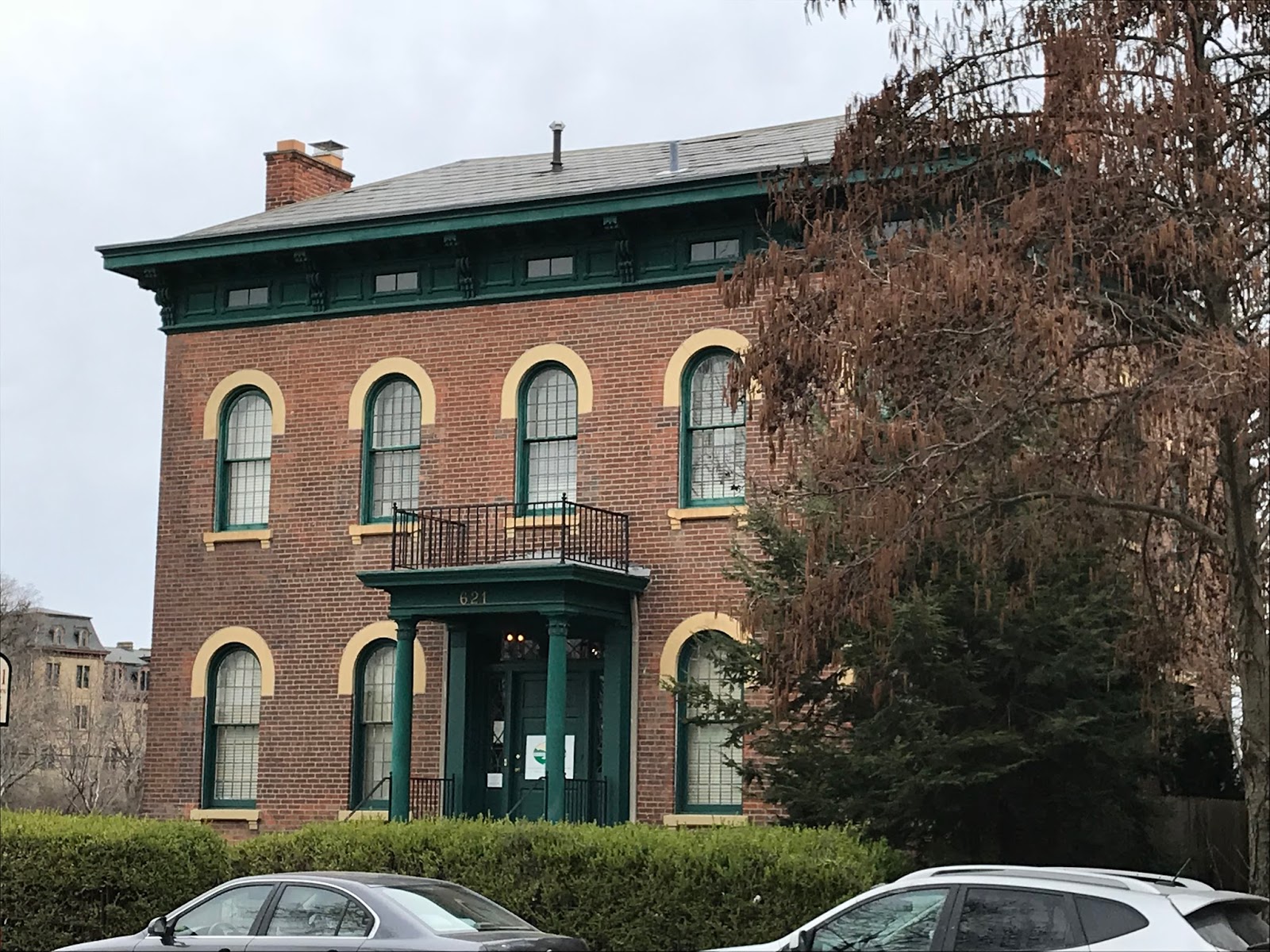
Built 20 years apart and standing at opposite edges of the East Town Street Historic District, these two five bay plan houses make an interesting pair. The Baldwin house, above, is the earlier and more elaborate of the two. It features a brick façade with exceptional moldings over the windows that consist of a segmental arch, blind, with foliate carvings and panels under an engaged triangular pediment. The cornice has a heavy architrave molding with paired brackets separating windows under a run of dentils. These brackets are rather unique, since most of their surface is flat with a rope molding, and only toward the top of the bracket do they curve out into a very sharp s curve with a finial at the end. The porch might be a later addition; the ironwork balcony over the front door, on the other hand, looks original, and the door may have featured a balcony resting on brackets. Finally, we have the low monitor/cupola with much bolder brackets. But a unique feature here is that the square windows feature wooden, pierced cut outs that give the windows the appearance of having concave corners. I actually really like the paint scheme on this house. It's very similar to those I see in my article on paint schemes illustrated in a book of the period.

The Spahr house, built for a reverend, is 20 years later, but not drastically different. Unfortunately, this house has suffered from some remodeling in the 1920s, with a new porch and very odd windows (18 over 18!). It looks to me that what once might have been more elaborate hood moldings have been cut down to flat forms, something that was all the rage in the early 20th century, perhaps as a way of reducing ornament. But the house does retain its paneled cornice with double s scroll brackets.


A third house of note is at 124 S Washington Street, a little ways from E Town. It is currently the Replenish Spa Co-op. One of the few houses we have seen that has its original porch, the delicacy of the details sets it apart. The house is also five bays, but the central bay sticks out from the façade and has a gable. The windows have engaged pediment moldings with Eastlake designs, resting on sculptural brackets. The central window in the gable is rounded with an eared surround. The cornice type is fringed, as it features a very fine trefoil fringe running as the architrave underneath the rotated s scroll brackets. This fringe is repeated on the gothic arch gingerbread in the gable, surrounded by fine jigsaw work of stars and rinceaux. The porch repeats these same decorative features, a fringe, which looks more Moorish than Gothic below, which runs under the gable and atop the posts. The brackets here have francy rinceauz on the sides and are elongated. Although I do not know anything about the house, it is definitely a product of the late 1860s or early 1870s.

Friday, February 23, 2018

'Orianda' the Thomas Winans House, Baltimore, MD

The Thomas Winans House, Baltimore, MD. 1856
Photo: Wikimedia
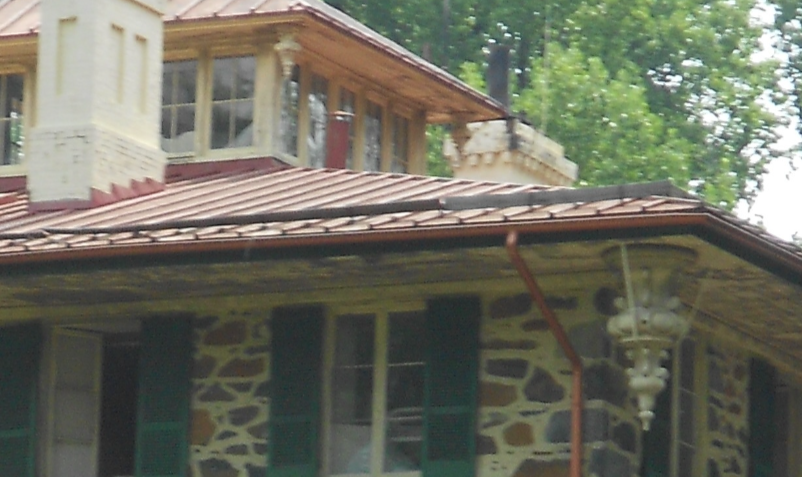
The Thomas Winans house is another one of these Russian themed estates of the 1850s. Winans' father was an inventor who worked on the construction of the Russian railroad, like Harrison in Philadelphia. He named his estate Crimea, after the peninsula in the Ukraine, and his house Orianda, after a Greek revival palace in the Crimea designed by Karl Friedrich Schinkel as one of his commissions for the Greek royal family (never built). The house has a five bay plan (the entrance is to the right of the above photo) with a porch around the door matching the porches to the sides and to the rear. The house, like other country houses around Baltimore, is finished in fieldstone with stone molded window lintels and simple decoration. The porch is quite attractive, with a lattice railing and ogee spandrel brackets. A cupola tops the whole almost entirely glass with a pointed roof. The house has no brackets, but instead uniquely features very strange thick gothic finials hanging down from the large eave at the corners of the house and cupola. This is a highly individualistic feature that rarely appears. It currently sits in the middle of a large park on a dramatic bluff overlooking a valley and is a museum and event facility (more images there).


Tuesday, February 20, 2018

'Tivoli' the Enoch Pratt House, Baltimore, MD

The Enoch Pratt House, Baltimore, MD. 1855 Photo: Wikimedia
'Tivoli' was constructed as the summer house of Enoch Pratt, one of Baltimore's major philanthropists and businessmen, in 1855. The house is a hulking mass, a three story, five bay plan of fieldstone and wood. The house has a string course that separates the second from the third floor. The window treatment is standard on the house, with a simple wooden surround and a molding above. Oddly, the house doesn't have an entrance porch, which I suspect was once there and similar to the back Tuscan porch, but has an entablature resting on brackets. The main entablature has c scroll brackets and is simple, akin to other country houses like 'The Mount'. It's here the house is particularly interesting. While on the front, an angular engaged pediment and arched window emphasize the center of the house, the side takes a different tack, dividing the façade into two main bays with stacked box windows with triple arched windows and panels above. These are topped by two engaged round pediments framing arched windows, contrasting with the angular front. A side service wing to the left offers a different scale, emphasizing its subordination to the main block. It is now the administration building of a mental hospital, finding new life like many of Baltimore's country houses, as an institution.

Saturday, February 17, 2018

'The Mount' the James Carey Jr. House, Baltimore, MD

The James Carey Jr. House, Baltimore, MD. 1858 Photo: Doug Copeland

Baltimore had some impressive country estates surrounding it, such as 'The Mount' built for a Quaker businessman and philanthropist, John Carey Jr in 1858 by William H. Reasin, a local architect. The house is supposed to be renovated soon, but seems to have caught on fire. Fortunately it was saved from destruction but remains vulnerable. The house is beautifully proportioned, with a five bay plan and a fieldstone façade with quoins; the windows have simple stone lintels. The central bay projects from the façade grandly, with an thick arch at the base a stone stringcourse and two arched windows above; basically there are three arches each diminishing with each floor. A row of bricks diagonally set into the sides of the projection where the stringcourse ends, indicates there was a porch once, now gone. The simple entablature has double s scroll brackets (with very shallow curves) and the whole is topped by a fine centered cupola with a broad eave and nicely framed triple arched windows. The house's massing and simple design makes it a beautifully simple villa. Hopefully, the house will be restored soon!

Wednesday, February 14, 2018

'Clifton' the Johns Hopkins House, Baltimore, MD

'Clifton' the Johns Hopkins House, Baltimore, MD. 1858 

Photo: Wikimedia
'Clifton' is another remodel of an earlier house, a five bay home built in the Federal style in 1803 for Henry Thompson. In 1838, it was bought by Johns Hopkins, the same university benefactor, and was remodeled in 1858 to its current Anglo-Italianate design by Niernsee and Neilson, a firm whose Baltimore work I have previously explored. The house has a five bay plan inherited from its previous incarnation, but the wings and tower placement are very unprecedented. Unlike Locust Grove, Niernsee did not disguise the original house, seen as the tall central block here, but rather expanded it drastically, making it the centerpiece of a much larger Italianate composition, adding Anglo-Italianate surrounds to the windows, a small entablature sequestering the third floor, and an entablature-less cornice with simple beam brackets. A broad porch was built linking the entire design and wing (an unexpectedly large porch!) with simple arches with bulls eyes in the spandrels resting on chamfered, paneled pillars. The bulkiness of the porch is relieved by a rather delicate railings with Roman-style crosses tied with bulls eyes. A simple beam bracket cornice completes the design with a pediment indicating the front entrance. The house gets very Italianate in its tower, connected by a wing with double tombstone windows with no surrounds. The tower covers a port cochere and seems to combine the full gamut of tower motifs with an arched window on the second stage, a Renaissance surround rectangular window on the third (with Renaissance balconies), a Romanesque series of drops that underlie a simple dentilled string course, an uncommon fourth stage with three deep panels and a window in the center, and on the fifth a triple arched window with an iron balcony surrounding the whole. This might be one of the tallest Italianate towers I have featured. The rear of the house has a polygonal bay and a very strange broad eave with c scroll brackets that fill almost the whole second floor, perhaps the most exaggerated brackets I have seen.

A blog post shows detailed shots of the house and the interior during renovation, with great images of the stunning plasterwork, fine stenciled walls, and unique woodwork. The design of the tower, semi detached and connected by a low wing suggests strongly to me Osborne House, one of the UK's premier Italianate palaces:

Photo: Wikimedia

Saturday, January 13, 2018

Detroit's Lost Italianates: The Isaac Swain House, Detroit, MI

The Isaac Swain House, Detroit, MI. 1863 Photos: Scott Weir


This post kicks off my discussion of a fascinating series of lost Italianates from Detroit. I have to especially thank Scott Weir for his collection of photographs of these gems. 19th century Detroit was one of the wealthiest, growing cities in the US, and that wealth as a transportation hub with close access to Canada and Michigan natural resources. Detroit was a well planned city from the earliest periods in its history, with broad boulevards, a grand street plan, and plenty of impressive homes constructed by the city's wealthy merchants. Unfortunately, the economic decay of the 20th century, as well as geographic changes in Detroit's fashionable areas took a major toll on the city's architectural heritage, as they have in most American cities. Wealthy Detroiters constructed their elaborate 19th century mansions near the downtown in neighborhoods that soon succumbed to business pressures and lifestyle changes. The Swain house, built in 1863 for an abstemious, uptight, and wealthy lumber merchant was built at 1115 Fort Street, a site now occupied by industrial buildings and an MDOT office near the highway. Still, for the purposes of this blog, lost homes are as valuable specimens as existing ones, in that they give us a clearer picture of the stylistic diversity of Italianate design.

The house is one of the most substantial Italianates featured on this blog (the biggest ones are always the first to fall). It follows the five bay plan with a strong central projection and appears to have been built of brick. The photo at the top of this page shows the house in the late 19th century, while the one below is closer to the period in which it was built; apparently the entrance porch was in need of some expansion at some point in the house's history. Chimneys seem also to have been added. All of the home's windows were arched (first floor round, second floor segmental) with extremely heavy drip moldings festooned with foliage and carved keystones. The windows on the top two stories of the central bay were both triple arched palladians. But while the porch and body of this house are not particularly elaborate, the cornice and upper stages are a testament to the possibilities of the lumber Swain made his fortune in. The height of the paneled cornice which is of the arched variety is extreme, giving the house a very top heavy feel. The elaborately carved brackets accentuate this, being expensive double s scrolls that alternate in size. A bold architrave molding with dentils below the windows places an exclamation mark on the overdone cornice. Additionally, the surprises continue as the eye moves upward, with an odd, seemingly hexagonal, cupola. The unusually tall cupola repeats the triple arched palladian windows and is topped by a very strange rounded railing with strong newel posts. This same railing, which almost looks art nouveau or jugendstil, seems to have been repeated, as the second image shows, further down on the roof, perhaps a second rooftop balcony. The cupola is also unique in that it is rare that a house has such strong gables also have a cupola, which is primarily associated with the hip roof. In a house of rooftop surprises though, the strange cupola merely completes the top heavy design.


Wednesday, January 10, 2018

'Floweree' the Charles Floweree House, Vicksburg, MS


The Charles Floweree House, Vicksburg, MS. 1866. HABS


This is perhaps Vicksburg's most impressive Italianate house (all images in this article comes from the HABS survey). Built in 1866 for Col. Charles Flowerlee, it is a rather uncomfortable hybrid Greek Revival/Italianate design that is an impressive and unique seven bay expansion of the five bay plan, finished in warm cream painted brick. The first floor features a central entrance with flanking windows and then two bay windows; these bay windows project slightly outside the façade, and are a strong Italianate feature seldom seen in these kinds of symmetrical houses. The central three bays have double height, square Tuscan pillars, hearkening back to the Greek Revival which run somewhat oddly into the bay windows, giving the house a strong variation of volumes with projections, diagonals, and varying shading effects, and presenting an exceptional sculptural quality. The top floor features a row of segmental arched windows with thick brick hood moldings, the same moldings seen in other Vicksburg Italianates that seem to be a local building trait. The windows flank a central grand entrance that repeats the paneled, pilastered decoration of the first floor entrance and the Greek Revival transom and side-lights fitted into a segmental arched frame, another Vicksburg feature seen in the Magnolias. The cornice is paneled, with filleted panel ends just like the Magruder house under a row of dentils; these are interrupted by c and s scroll brackets in pairs at the accent points of the house. Surprisingly, the house has a tall gabled roof instead of an expected hip roof, and a large seven bay Italianate conservatory projects from the back. The house is certainly an uncommon and individualistic design, but the contractor and designer are unknown; perhaps, given similarities to other houses in the area, it is a Beck design or a local tastemaker.

The interiors of the house are especially impressive, with some of the finest, most florid, and deepest plasterwork in the state. Every surface seems to have some viney outgrowth emerging from it. The house is for sale, and the realtor website has several color images of the exterior and interior. A video slideshow is also available. HABS fortunately provides some drawings, plans, and interior images.

Elevations:


 Plans:


 Interiors:


Sunday, January 7, 2018

The Alexander Magruder House, Vicksburg MS

The Alexander Magruder House, Vicksburg MS. 1850 Photo: Wikimedia

Source: Wikimedia
This house was built in 1830 as a single story house in the Greek Revival style by Richard Featherston, but was remodeled into a two story Italianate structure in 1850 by Alexander Magruder, a doctor. It is a five bay symmetrical design, reflective of its Greek Revival roots, with sparing details, and a noticeable lack of window surrounds (the tracery looks to be an addition of the 1890s). The facing appears to be some kind of stone or perhaps a very deeply scored and textured plaster, with quoins in the corners, giving it a rather grand frame. The entablature on both the porch (with thick, square, Greek Revival pillars) and the house match, following the paneled style with sharply angular brackets. Perhaps its most attractive feature is the main door, which has an elaborate pilastered surround with panels matching the entablature, curvaceous brackets, and a fine basket handle arch transom. The house is currently a place one can rent to stay in. The fine and tastefully decorated interiors can be seen here.

Source: Jeff Hart
I'd like to mention another Italianate here, the demolished rectory of St. Paul's church (all images from HABS).


It was built in 1866 and designed by the priest, Jean Baptiste Mouton, and pieces appear to have been prefabricated in Ohio and shipped down. Despite the Gothic detailing, the house is solidly Italianate, given its cornice with angular brackets closely spaced, its symmetrical five bay plan, and its hip roof. It is one of several hybrid Italianates, like Indian Italianates, with a different stylistic vocabulary applied to a Italianate frame. Here, the Gothic details consist of window labels in a Gothic vein, a Gothic porch with a heavy ogee arch, and pointed windows. This last feature is an interesting transformation of the typical Italianate triple arched palladian into a Gothic formation. The whole façade was stuccoed and scored to appear like stone, making the undoubtedly brick house match the grandeur of Gothic stonework. Unfortunately, this was demolished in 1972.


Sunday, December 17, 2017

The Eli Slifer House, Lewisburg, PA

The Eli Slifer House, Lewisburg, PA. 1861. Source: otandka
Source: Bill Badzo
Source: Wikimedia
Eli Slifer commissioned Samuel Sloan to design his country house in Lewisburg, completed in 1861, just as the Civil War was breaking out in which Slifer played a major role as a bigwig in state government. In this house, we can see Sloan moving somewhat away from all of his precedents and into more creative territory in design. While the plan and first two floors look like most of Sloan's five bay symmetrical plan houses, such as the Packer house, to which this bears some similarity, above the roof, Sloan has raised the roof pitch dramatically to accommodate tall central gables. An additional oddity is the placement of the tower in the rear, invisible from the front unless one stands at just the right angle to see its steeply pitched tent roof poking out. So emphatic is the right side of the house, that it almost becomes a principal façade in competition with the main façade. The design of the house is rather spare, with no window surrounds, though this would appear much less cheerless if the shutters were restored. The façade as well seems to have been faced in fine stone, now obscured by a rather rough plaster job. The front of the house features a simple porch that extends around the design, very much a Sloan standby which softens the mass of the main body and expands the profile. The central window is paired with a curved wooden awning over it, uniting the two. The dramatic gable, with paired tombstone windows, has bargeboards, decorative wooden boards attached to the cornice, with a few whimsies thrown in for drama. The simple beam brackets are mostly obscured by the angled eave overhang. The right side features a large fringed second floor balcony, perhaps the frilliest thing on this mostly somber design. The tower's curved roof is a feature that hearkens back to an earlier stage of Italianate, with balconies and triple arched windows. In a sense, one might consider the placement of this tower along side the rear towers found in Woodland Terrace.

Sloan published his design for this house in Homestead Architecture, as Design 33.


After serving as a religious institution for many years, the house is now a museum. On their website is a gallery of interior images, which indicate the house seems appropriately furnished for its period.

Wednesday, May 11, 2016

'Bellevoir' the Hamilton Ormsby House, Lydon, KY

Hamilton Ormsby House, Lyndon, KY 1867 Photo: Wikimedia
The Hamilton Ormsby house was built from 1864-7 to replace an earlier house that had burned. It is one of several impressive country houses in the suburbs of Louisville. The house was originally part of a large estate of the Ormsby family; it was sold in 1912 to become the site of the Louisville Children's home and is now the caretaker's house. The house is very grand for a country estate, but that's hardly a surprise when approaching the south, where country estates served as major showplaces and objects of competitive building. The house is a five bay plan structure with a brick facade embellished with stone quoins at the corners. The central bay is emphasized by greater width, projecting out from the facade, and featuring paired tombstone windows. The house's other windows are all segmental arched, establishing a pleasant undulating rhythm to the design. The window hood moldings are uniform across the facade, with a conforming molding with deep dentils and acanthus brackets. The central bay is again distinguished by having Gothic-style drops with rosettes in the molding rather than dentils. The simple entablature, with architrave moldings, frieze windows, dentils, and double s scroll brackets finishes off the house nicely. But perhaps the most impressive feature, echoing the windows' undulation is the porch across the central three bays, formed of the laciest ironwork and curving out from the facade in a wide circle. The impossibly thin supports are topped by a rococo entablature with a fringe. This combination of thin ironwork and heavy blocky design reminds me of English Regency designs, where contrast is drawn between the porousness of the iron and the solidity of the house.

Tuesday, May 3, 2016

The Frank Hearne and Alfred Lamb Houses, Hannibal, MO

Frank P. Hearne House, Hannibal, MO. 1871 Photo: Mike Steele
Alfred Lamb House, Hannibal, MO. 1859 Photo: Mike Steele
Sitting across from each other on Bird Street in Hannibal, are two impressive Italianates, the Hearne and Lamb houses. The Frank P. Hearne house, above, was built in 1871 for a lumber merchant. The house has a plain side hall facade facing 6th St. but this view of the side shows its impressive irregular plan side facade on Bird St., a duality that gives it a rather schizophrenic quality. I prefer this facade. One can see the completely towerless irregular form and the longer left-hand facade which brings the house out to 6th St. The simple brick facade is pierced with segmental arched windows that have pedimented stone label moldings above, creating a nice interplay between rounded and angular forms. The cornice has smart-looking and frequent paired small brackets on a subdued entablature board that give it a sophisticated air.

This lower house was built by Alfred Lamb a railroad president in 1859. Since this photo, the house has been beautifully restored by expert restoration craftsmen and is now the Belvedere Inn. It follows the five bay plan with a hip roof. The segmental arched windows on the second floor are topped with especially fancy cast iron rococo hood moldings. The porches have been restored with all their splendor. What catches my eye especially on this house though is its massive cupola, perhaps the largest cupola I have posted on this blog. The cupola is rectangular, rather than square as expected, and each bay of the cupola has two arched windows with eared surroundings and dentils. The sides are twice as long as the front. I'd imagine that given its size, it must produce a sizeable interior space that has more functionality than the typical cupola.