 | |
| Photo: Lewisburg Architectural Project |
Showing posts with label Pennsylvania. Show all posts
Showing posts with label Pennsylvania. Show all posts
Tuesday, April 9, 2019
The Justin Loomis House, Lewisburg, PA

Saturday, April 6, 2019
The Daniel Bright Miller House, Lewisburg, PA
 |
| Miller House, Lewisburg, PA. 1860s All Photos: Lewisburg Architecture Project |


Wednesday, April 3, 2019
The James S. Marsh House, Lewisburg, PA
 | |||
| The James S. Marsh House, Lewisburg, PA. 1860s Photo: Joseph a |
It is a tour de force of Italianate design and includes all sorts of bells and whistles. It is a symmetrical five bay house with a gable roof and, unusually, a cupola. Usually cupolas are placed on hip roofs and not gabled roofs. On the first floor, the house has segmental arched windows and on the second and third round arched windows. All have a similar drip molding that conforms to the arch shape and ends in Gothic style finials and almost all have Venetian tracery. In the center is a triple arched palladian window, also with a conforming molding. The designer even put grand windows in the attic story at the end, a rather expensive decision. The finish is stucco with impressive quoins at the corners and a rusticated basement. The front looks a little bare. It's likely that it had an entrance porch that matched the side porch, a rather rich design with a fringe, s and c scroll brackets, and arches interrupted by carved keystones and a wooden fringe. The cornice is the fillet cornice type with a deep architrave and filleted panels alternating with filleted windows topped by a run of fringe made by pieces of wooden molding. The brackets are s scroll type and the sides form curved rinceaux. Particularly lavish is the cupola with wood rusticated to look like masonry. The backets and two windows match the facade windows with Venetian tracery and strong moldings with added multi eared surrounds. A different cornice type, the undulating cornice was used here. An earlier view of the house shows a grand balustrade on the cupola and a balustrade atop both porches. These things always rot off.


Friday, December 22, 2017
Summing Up Sloan
After 1861, Sloan's commissions declined, since the Civil War put a stop to most new residential construction as resources were shifted to the war effort. During the same time, Sloan's southern commissions as well fell by the wayside. After the war, most of Sloan's work in the north began shifting to Addison Hutton, his protégé, as he spent more and more time on his periodicals. Sloan moved more towards institutional work as well, updating his repertoire to the newly popular Second Empire and later early Queen Anne. Sloan died from a stroke in 1884 in North Carolina, his new office site.
A Sloan Stylistic Typology
What remains is to identify a typology for determining a Sloan production or a design influenced by Sloan. Key characteristics of Sloan's design can be see in this paradigmatic house from Woodland terrace:

A list of key characteristics (in a typical three story house) might be:
-A strong differentiation between all three floors
-A generous porch around the majority of the first floor
-Simple design in porches with a minimum of elaboration and thin posts, often paired
-Tall second floor windows, usually rectangular (sometimes paired and arched), often with a simple molding or eared surrounding molding
-A strongly marked third floor separated by a string course and featuring paired arched windows
-Paired rather than continuous or single brackets, usually widely spaced
-An engaged gable, that is a flat cornice forming a central gable; typically brackets are inserted in the gable
-Stucco or stone surface finishes, often with quoins
-A strong central mass with complex massing and volumes emerging from it, especially favoring complex side facades
-Triple arched windows in towers, placed either in the center or to the side
-A fascination with symmetry and central, balanced compositions, both in individual designs as well as in streetscapes
-A taste for simplicity over heavy ornamentation
Sloan's Influence
It is this architectural vocabulary that provided the template for the Philadelphia Italianate aesthetic in composition, particularly in West Philadelphia and the suburbs. So strong is this stylistic register, that there is often quite a bit of uncertainty on whether a building is by Sloan, influenced by Sloan, by an imitator, or based on a published Sloan plan. There are a variety of doubtful attributions or possible attributions. But no one can argue that Sloan, even outside of his pattern books whose travels spread Sloan's aesthetic beyond Pennsylvania, was wildly influential. Within Philadelphia, one can see several Sloan style houses in Powellton Village in West Philadelphia:


 This is a very close reproduction of one of the central units on Woodland Terrace. Note the Indian style cupola, a unique feature that selects from Sloan's more exotic designs.
In further posts, when a house stylistically connects with one of Sloan's plans, I'll note it. No venture would be more appropriate to an architect who sought to reform American tastes both by his own direct work and his printed designs. In doing so, Sloan showed himself as a peer of the first popularizer of the style, Alexander Jackson Davis, whose own published plans vied with Sloan's in bringing the style across the country. As one can see, Sloan's Italianate styling is a key development in 19th century architecture in not only Philadelphia, or the mid-Atlantic, but also in the US.
A Sloan Stylistic Typology
What remains is to identify a typology for determining a Sloan production or a design influenced by Sloan. Key characteristics of Sloan's design can be see in this paradigmatic house from Woodland terrace:

A list of key characteristics (in a typical three story house) might be:
-A strong differentiation between all three floors
-A generous porch around the majority of the first floor
-Simple design in porches with a minimum of elaboration and thin posts, often paired
-Tall second floor windows, usually rectangular (sometimes paired and arched), often with a simple molding or eared surrounding molding
-A strongly marked third floor separated by a string course and featuring paired arched windows
-Paired rather than continuous or single brackets, usually widely spaced
-An engaged gable, that is a flat cornice forming a central gable; typically brackets are inserted in the gable
-Stucco or stone surface finishes, often with quoins
-A strong central mass with complex massing and volumes emerging from it, especially favoring complex side facades
-Triple arched windows in towers, placed either in the center or to the side
-A fascination with symmetry and central, balanced compositions, both in individual designs as well as in streetscapes
-A taste for simplicity over heavy ornamentation
Sloan's Influence
It is this architectural vocabulary that provided the template for the Philadelphia Italianate aesthetic in composition, particularly in West Philadelphia and the suburbs. So strong is this stylistic register, that there is often quite a bit of uncertainty on whether a building is by Sloan, influenced by Sloan, by an imitator, or based on a published Sloan plan. There are a variety of doubtful attributions or possible attributions. But no one can argue that Sloan, even outside of his pattern books whose travels spread Sloan's aesthetic beyond Pennsylvania, was wildly influential. Within Philadelphia, one can see several Sloan style houses in Powellton Village in West Philadelphia:

This house, for instance, reproduces Sloan's design in detail from the southern end units of Woodland Terrace.

This house is very Sloan like with most of the stylistic features identified above. It closely models itself on Sloan's published central tower five bay plans.


These three houses closely resemble Sloan's work on Pine Street and Woodland Terrace. You can see many Sloan features evidenced in each house. On the last one note the off center placement of the tower.

In further posts, when a house stylistically connects with one of Sloan's plans, I'll note it. No venture would be more appropriate to an architect who sought to reform American tastes both by his own direct work and his printed designs. In doing so, Sloan showed himself as a peer of the first popularizer of the style, Alexander Jackson Davis, whose own published plans vied with Sloan's in bringing the style across the country. As one can see, Sloan's Italianate styling is a key development in 19th century architecture in not only Philadelphia, or the mid-Atlantic, but also in the US.
Sunday, December 17, 2017
The Eli Slifer House, Lewisburg, PA
 |
| The Eli Slifer House, Lewisburg, PA. 1861. Source: otandka |
 |
| Source: Bill Badzo |
 |
| Source: Wikimedia |
Sloan published his design for this house in Homestead Architecture, as Design 33.


After serving as a religious institution for many years, the house is now a museum. On their website is a gallery of interior images, which indicate the house seems appropriately furnished for its period.
Wednesday, December 13, 2017
Woodland Terrace, Philadelphia PA
 |
| Woodland Terrace, Philadelphia PA. 1861. |
Sloan arranged the progression of houses with an eye to symmetry without creating monotony, an eye for large scale composition he demonstrated on Pine Street. On the east side of five bays this can be seen best. The two end units follow the irregular plan, but while the northern house has a stubby gabled tower with two rectangular windows, the south house has a full hip roof tower with triple arched windows. The three central units follow the symmetrical plans, but units two and four do not have cupolas, while the third unit in the center has a large cupola divided between the two houses with four arched windows, marking the center of the block and creating emphasis. Sloan has masterfully balanced the composition with regularly spaced focal points in units one, three, and five and provided a deemphasized background in units two and four. This design was somewhat complicated in its repetition on the west side, since the even number of houses prevented the central focal point. Sloan handled this by putting cupolas on both houses in the center, three and four, maintaining a central focus. The most unfortunate loss is the demolition of half of the final unit on the west side, depriving that section of its grand punctuating tower.
All the houses were designed consistently, with facades of irregularly cut brownstone (a Pennsylvania specialty) divided into three floors, with rectangular windows on the first two floors with bracketed hood moldings, a stringcourse between the second and third floors, with arched windows on the third floor and paired brackets. The brackets are of the double s scroll type. The principal facades feature fine cut brownstone, while the sides are made of irregular fieldstone. The porches are simple, with small brackets, sinuous ogee curves, and thin paired posts supporting the porch (lost in a few examples). That is the base design that forms the stylistic unity between each unit. Originally, the houses would probably have featured a very consistent paint scheme, avoiding the jarring effect when owners paint different sides of a unified house different colors, divided in the middle. The entire ensemble was photographed by HABS.
The East Side of the row:


The West Side:


Another double house of interest, sadly demolished, one block over from Woodland Terrace at 435 S. 40th Street where the transit station is now. The house featured two towers surrounding a central block of paired windows with wooden awnings, balconies, and an elaborate arched porch with fine jigsaw work. While not attributable as Sloan, and perhaps a bit too fanciful for him, nonetheless, it displays Sloan's influence in its fascination with varied massings, differing volumes, and variety in design, producing a balanced symmetry.

This same design, certainly by the same builder could be seen rendered in Second Empire on Baltimore Avenue:

A final Italianate of interest in a very Sloan like style could be found across the street from the 40th street houses, at 440 S. 40th Street. It looks like it might have been a triple house by the number of entrances. The house follows the pavilion plan, though somewhat asymmetrically. A large pavilion on the left featured a two story bay window (with a tower to the rear), while the left hand pavilion was two bays, evenly spaced. The central four bays had a large porch running across the front. The quoins, the string course, the side placement of the tower, and the simple porch are all highly reminiscent of Sloan's designs nearby on Pine Street and demonstrate his influence in the area.


Monday, December 11, 2017
Sloan's "City and Suburban Architecture"
City and Suburban architecture was published in 1858 and represented a very different side of Sloan from his Model Architect. While previous publications had focused on primarily residential and garden designs, CS offered plans for churches, houses, commercial, institutional, and industrial buildings. All these idioms were practiced by Sloan (recall he was most prolific in his schoolhouse designs). Sloan's residential designs in CS were primarily for row houses of stone, rather than the expansive and imaginative rural villas in MA. CS includes as well far more detail renderings of doors, windows, and architectural do-dads.
There are a series of shared characteristics to this volume. It reflects the more urban work that Sloan did for Joseph Harrison in connection to his house on Rittenhouse Square (featured as the final design in the volume) and his work in designing Harrison's developments both in the city and in West Philadelphia. These designs were far more Anglo-Italianate in inspiration, mostly designed as rowhouses in stone. The depressed arched windows with Venetian tracery are ubiquitous as well as the presence of rusticated first floors, all features from Harrison's house. They feature heavy window moldings and an interesting eclecticism with a mixture of classical Renaissance, rococo, and Rundbogenstil Romanesque decorative elements. The idiom expressed in this can be found all over Philadelphia, for instance in the Deaconess Training School.
Design 2:
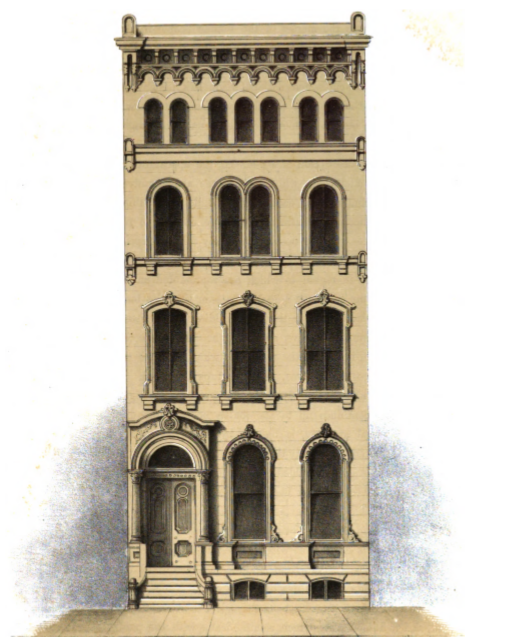


This is a design of impressive variation for the typical three bay rowhouse. Each floor is carefully differentiated with the third and fourth floors varying the window placements and groupings to give a greater illusion of pavilions and varied volumes. The detailing is eclectic with rococo revival carved foliage and Romanesque details and drops under the bracketed entablature.
Design 5:


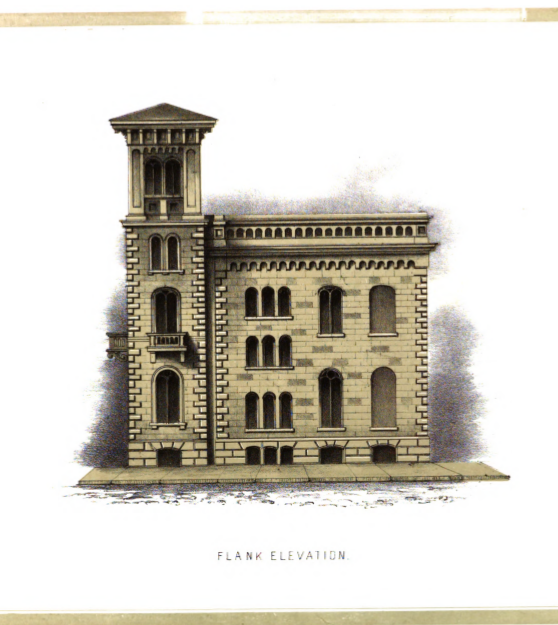


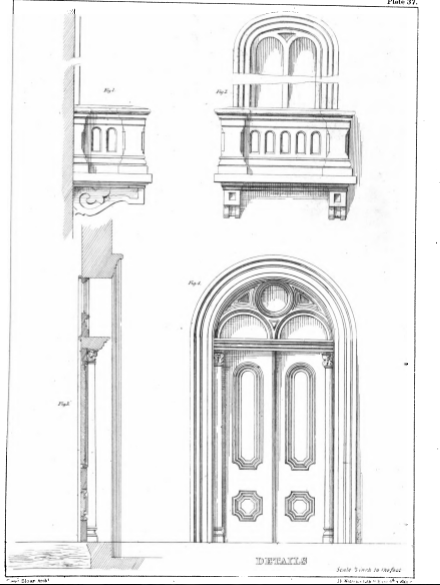
This is a rather fanciful rowhouse design for the end of a block with a tower. There are several correspondences with the Harrison house, including the use of depressed arches with Venetian tracery. The detailing here as well is eclectic, blending Rundbogenstil Romanesque designs with Anglo-Italianate classical detailing. Note the false wall in the rear.
Design 10
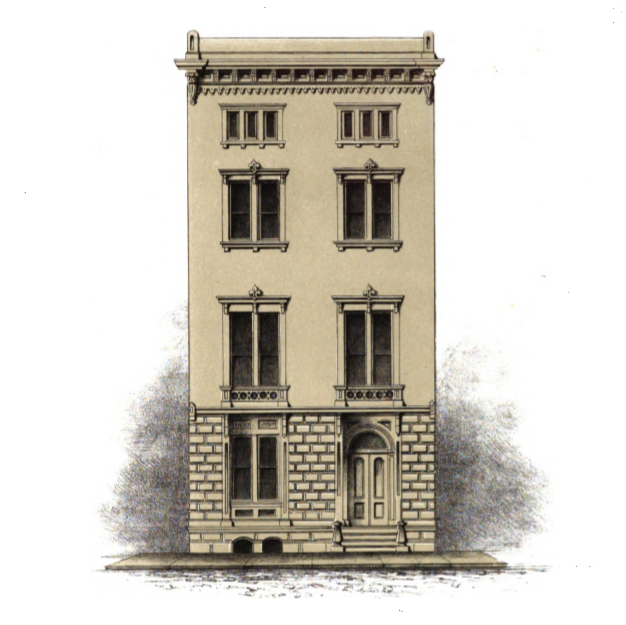


This is a more stylistically consistent design, with rococo forms, a rusticated basement, and only a small Romanesque fringe.
Design 11:


A particularly lavish basement with both rustication and pilasters and Sloan's signature depressed arch windows and Venetian tracery. The paired windows on the top story are a signature Sloan design.
Design 15:


Similar to Design 10 but with a fancier basement and balconies.
Design 16:

Design 17:

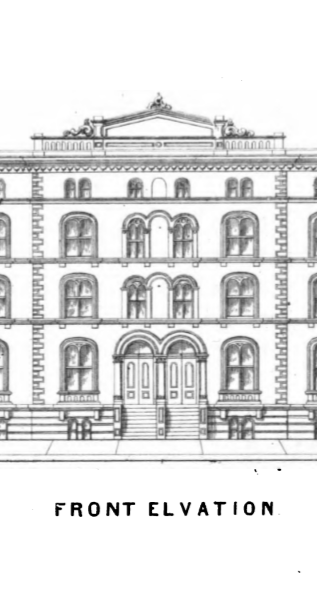


A plan for an entire row of 10 houses. This was likely the row that Sloan built for Joseph Harrison behind his house at Locust Street. It very closely matches the style of Harrison's house, especially in the treatment of the attic and window designs.
Design 19:


A high style symmetrical plan house with thick classical details.
Design 27:


Design 28:


Design 30:


Subscribe to:
Comments (Atom)