Showing posts with label row house. Show all posts

Monday, December 11, 2017

Sloan's "City and Suburban Architecture"

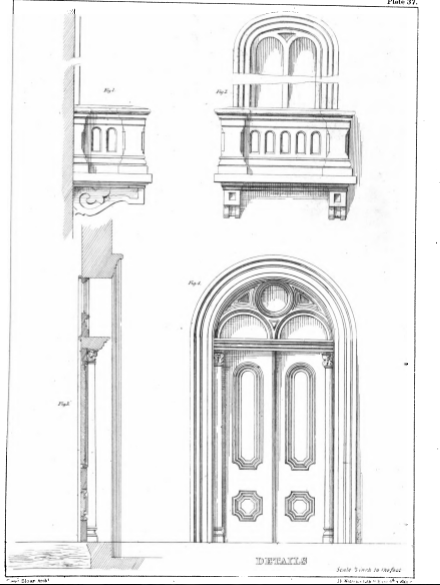
City and Suburban architecture was published in 1858 and represented a very different side of Sloan from his Model Architect. While previous publications had focused on primarily residential and garden designs, CS offered plans for churches, houses, commercial, institutional, and industrial buildings. All these idioms were practiced by Sloan (recall he was most prolific in his schoolhouse designs). Sloan's residential designs in CS were primarily for row houses of stone, rather than the expansive and imaginative rural villas in MA. CS includes as well far more detail renderings of doors, windows, and architectural do-dads.

There are a series of shared characteristics to this volume. It reflects the more urban work that Sloan did for Joseph Harrison in connection to his house on Rittenhouse Square (featured as the final design in the volume) and his work in designing Harrison's developments both in the city and in West Philadelphia. These designs were far more Anglo-Italianate in inspiration, mostly designed as rowhouses in stone. The depressed arched windows with Venetian tracery are ubiquitous as well as the presence of rusticated first floors, all features from Harrison's house. They feature heavy window moldings and an interesting eclecticism with a mixture of classical Renaissance, rococo, and Rundbogenstil Romanesque decorative elements. The idiom expressed in this can be found all over Philadelphia, for instance in the Deaconess Training School.

Design 2:
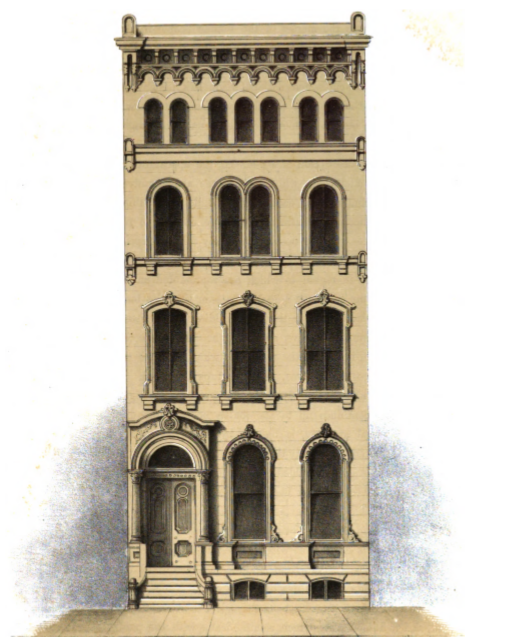


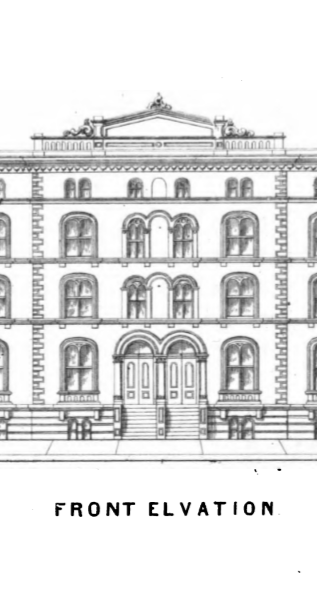
This is a design of impressive variation for the typical three bay rowhouse. Each floor is carefully differentiated with the third and fourth floors varying the window placements and groupings to give a greater illusion of pavilions and varied volumes. The detailing is eclectic with rococo revival carved foliage and Romanesque details and drops under the bracketed entablature.

Design 5:


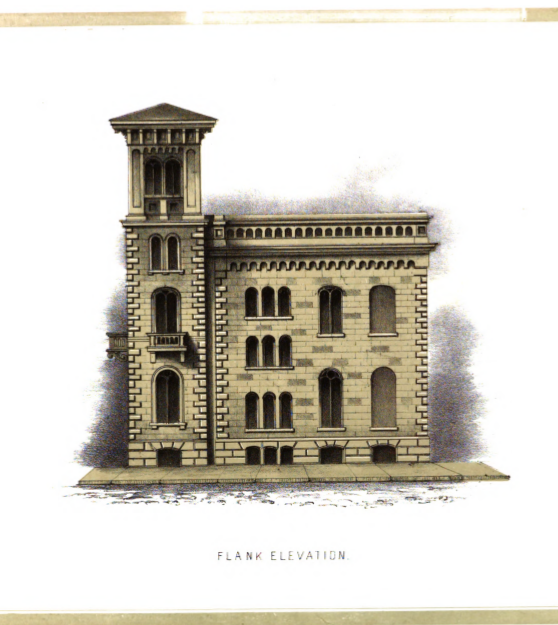
This is a rather fanciful rowhouse design for the end of a block with a tower. There are several correspondences with the Harrison house, including the use of depressed arches with Venetian tracery. The detailing here as well is eclectic, blending Rundbogenstil Romanesque designs with Anglo-Italianate classical detailing. Note the false wall in the rear.

Design 10
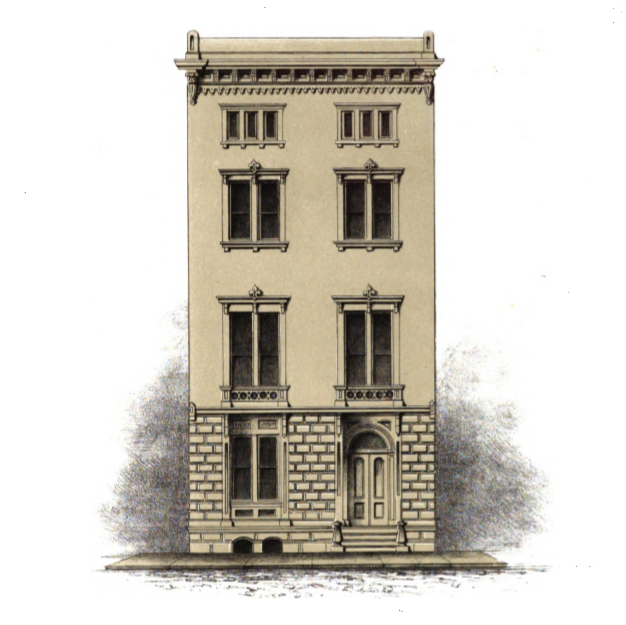


This is a more stylistically consistent design, with rococo forms, a rusticated basement, and only a small Romanesque fringe.

Design 11:


A particularly lavish basement with both rustication and pilasters and Sloan's signature depressed arch windows and Venetian tracery. The paired windows on the top story are a signature Sloan design.

Design 15:


Similar to Design 10 but with a fancier basement and balconies.

Design 16:


A variation on Design 15 but with heavier classical detailing and a simpler basement.

Design 17:


A plan for an entire row of 10 houses. This was likely the row that Sloan built for Joseph Harrison behind his house at Locust Street. It very closely matches the style of Harrison's house, especially in the treatment of the attic and window designs.


Design 19:


A high style symmetrical plan house with thick classical details.

Design 27:


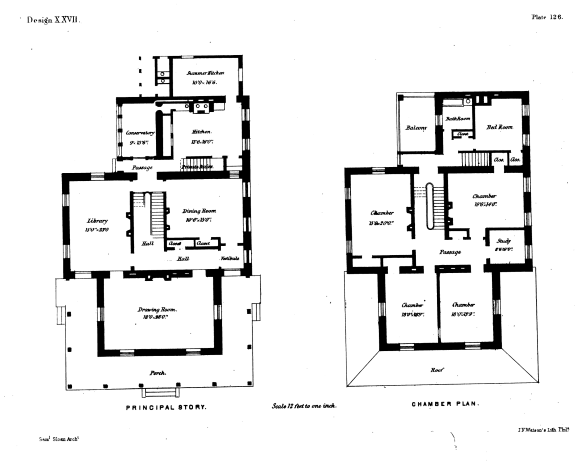
One of Sloan's suburban detached designs. The house at Pine Street may have been designed based on this, though the triple window in the gable is far larger in the example. These designs are likely reflective of his work for Harrison in West Philadelphia.
Design 28:


Design 30:


Thursday, July 28, 2016

The William Loftland House and the William D. Baker House, Philadelphia, PA


The William D. Lofland House, Philadelphia, PA. 1854
The 1854, William Lofland house, 4100 Pine St at the corner of 41st, is perhaps one of my favorite houses in Philadelphia. In this building, Sloan created a unique profile perhaps based on Design 9, although many of Sloan's designs feature central gabled towers as a feature. I'm going to call it a central tower design. All of these, however, have a central entrance, while in this house, the entrance has been shifted to the left of the tower. Unfortunately, the destruction of the right hand side of the house doesn't do us any favors in understanding its original appearance. The size would indicate a double house, but the information in Sloan's work doesn't show that this was constructed as a double, making it one of West Philadelphia's more substantial private villas. It was a speculative design for Lofland.

Starting at the central tower block, Sloan has a three story element that has a fine bay window on the first floor topped by an impressive three bay iron porch, a rather unique feature. The left hand of the front façade features the arched entrance and another delicate iron porch with its original tent roof. The side façade uniquely has a wing with a small tower in the rear. This is strange, since towers are usually presented as a dominant feature on the design and rarely placed in the back of a house. Details include a straightforward stucco finish and mostly rectangular windows (arches are only used on special features like the bay window and tower) topped with Greek Revival anthemia. There is no strong architrave, and the brackets used on the main façade are unexpectedly small s curve types. Larger brackets are employed on the rear tower. Note the decorative chimneys as well, a particularly picturesque detail. I really hope someone decides to fix this house up and restore it. It's one of the most interesting Italianates in all of West Philadelphia and is remarkable for its surviving details. Plus, with the large wall around the property (maybe later) and its studied asymmetry, it looks more like its rustic Italian precedents than many examples of the style.


Of the same period are probably two other Sloan-style (they can't be fully attributed to him, but the ascription is extremely likely) buildings on 40th Street between Pine and Baltimore Ave. These probably also date from the early 1850s and are contemporary with the rest of the area's development.


The first is an interesting series of four row houses. The shallow central gables and those over the doors fit in very closely with Sloan's style, as does the style of the brackets (matching those on the central house on Pine Street, the finish, and the brownstone quoins on the corners. Like other Sloan doubles we have seen, Sloan has worked hard here to create a composition that doesn't simply look like a blocky row of individual houses, but strives to create a unified single building out of several dwellings.


The second is an interesting building that seems to consist of several houses. It may have been built as a double and later altered for commercial uses, as this was primarily a residential neighborhood and interestingly navigates its odd trapezoidal lot. It looks like a rather gussied up version of MA Design 8 with its central, three-story tower flanked by two story sections. In this case, the tombstone windows on the sides would be consistent with Design 8, and the original first story would have had paired rectangular windows with a shared entrance in the central block. Differences consist of the treatment of the central section (modified for a double house) and the engaged pediments on the side pavilions.

The William D. Baker house, Philadlphia, PA. 1854.
There seems to be a bit of confusion about who the house at 4207 Walnut was built for. Cooledge says William D. Baker, but others Judge Allison. It's slightly confusing because Sloan built about five houses in this area all in 1854 for several different clients, and the descriptions are not entirely clear in determining which is which. The house is currently the Walnut Hill Culinary School. It's an impressive size symmetrical plan house (it could also be labelled a five bay plan) with a strong severity in the design. The most intriguing feature of the design are the recessed panels that define the bays, a treatment Sloan explored in MA Design 20, though the house follows roughly MA Design 36. The design is spare in its details with simple moldings (on the second floor with anthemia, as seen on the Alpha Psi house on Pine). The entablature is elongated with an architrave molding running below third floor windows with panels and pilasters in the central three bays; the brackets are again very diminutive here. The porch, in contrast to the massiveness of the house is surprisingly wiry, and to the right is an odd little wing with tombstone windows and an archway, the function of which is rather unclear. Had the neighboring house not been demolished, it might be clearer.

Some of the remnants of Sloan's other houses in the area survive.

Others have been demolished.

4045 Walnut

4203 Walnut (Comegy House) c. 1860


Wednesday, March 16, 2016

The Charles McLeod House, Troy, NY

The Charles McLeod House, Troy, NY. 1867

The house at 149 Second Street in Troy, built in 1867 for Charles McLeod, the vice president of a stove manufacturing company, is one of the most sophisticated designs in the area. It has gone through a variety of owners after the McLeods after 1907 and was altered in 1885,  It follows the side-hall, row house plan, although the left-hand bays are filled with a large three story bay window. The facade is articulated in fine brownstone which is distributed in a series of pilasters, blind panels, and horizontal string courses. These features are usually associated with the "Brick-panel style" known from Boston. Because the panels and pilasters form the facade's articulation, window and door surrounds are kept simple. The front doors themselves with their rich carving and the odd insertion of a round arch into a segmental arch are one of the finest sets of Victorian doors in the city. The impressive bay window is especially interesting, as it is so heavily defined by thick cornices and is framed so well by the facade's pilasters. The first and second floors feature filleted openings with rectangular windows inside them. The top floor draws the eye up with arched windows with floating triangular pediments connected by keystones and brackets to the windows. The elaborate paneled cornice completes the design, with s-scroll brackets with carved acanthus leaves and panels with blocks in the corners. The house is currently the home of a wellness retreat and suffered a devastating fire in 2010. Fortunately, the owners love Victorian architecture and have worked tirelessly to rebuild and restore the grand interiors with fine woodwork and painting, images of which can be seen here.


Further down the street back towards Washington Park is another fine brownstone at 167 Second Street. This house was no doubt another product of the late 1850s and is a fine tribute to the segmental arch in a row house plan. A severe brownstone facade with all the demureness of Anglo-Italianate design, features simple hood moldings and a very plain cornice. The largest note of fun is the door which has a full molded surround with a riot of rococo vegetation flowing from the top.

The last little note, across the street is probably one of the coolest, almost intact runs of temple-front Greek Revival houses. You almost never see them all lined up like this, especially in an urban setting.