 |
| The Albert H. Caroll House, Baltimore, MD. 1860 Photo: Wikimedia |
Showing posts with label Baltimore. Show all posts
Showing posts with label Baltimore. Show all posts
Monday, February 26, 2018
'Evergreen on the Falls' the Albert H. Carroll House, Baltimore, MD

Friday, February 23, 2018
'Orianda' the Thomas Winans House, Baltimore, MD
 |
The Thomas Winans House, Baltimore, MD. 1856
Photo: Wikimedia
|
Tuesday, February 20, 2018
'Tivoli' the Enoch Pratt House, Baltimore, MD
 |
| The Enoch Pratt House, Baltimore, MD. 1855 Photo: Wikimedia |
Saturday, February 17, 2018
'The Mount' the James Carey Jr. House, Baltimore, MD
 |
| The James Carey Jr. House, Baltimore, MD. 1858 Photo: Doug Copeland |
Baltimore had some impressive country estates surrounding it, such as 'The Mount' built for a Quaker businessman and philanthropist, John Carey Jr in 1858 by William H. Reasin, a local architect. The house is supposed to be renovated soon, but seems to have caught on fire. Fortunately it was saved from destruction but remains vulnerable. The house is beautifully proportioned, with a five bay plan and a fieldstone façade with quoins; the windows have simple stone lintels. The central bay projects from the façade grandly, with an thick arch at the base a stone stringcourse and two arched windows above; basically there are three arches each diminishing with each floor. A row of bricks diagonally set into the sides of the projection where the stringcourse ends, indicates there was a porch once, now gone. The simple entablature has double s scroll brackets (with very shallow curves) and the whole is topped by a fine centered cupola with a broad eave and nicely framed triple arched windows. The house's massing and simple design makes it a beautifully simple villa. Hopefully, the house will be restored soon!
Wednesday, February 14, 2018
'Clifton' the Johns Hopkins House, Baltimore, MD
 |
'Clifton' the Johns Hopkins House, Baltimore, MD. 1858
Photo: Doug Copeland
|
 |
| Photo: Wikimedia |
A blog post shows detailed shots of the house and the interior during renovation, with great images of the stunning plasterwork, fine stenciled walls, and unique woodwork. The design of the tower, semi detached and connected by a low wing suggests strongly to me Osborne House, one of the UK's premier Italianate palaces:
 |
| Photo: Wikimedia |
Monday, March 28, 2016
'Homewood Villa' the William Wyman House, Baltimore, MD
 |
| Homewood Villa, Baltimore, MD. 1853 Photo: Courtesy of Maryland Historical Society, [B330] |
The house is a perfect example of the double tower plan and matches the King house in Newport very closely, even in the details. Not only does the house have almost the same fenestration pattern and variation, but even the wooden awnings, balconies, and open pediments were reproduced. It's the differences between the two houses that are most significant. First, the most noticeable difference (besides the reversal of the plan) is the taller tower is a full stage taller than in the King house, giving Homewood Villa a far more vertical thrust as well as creating even more drama in the profile. The added stage has been treated with a small round window with Gothic tracery on the front and tombstone windows on the sides. Another feature is the porches. The King house lacks porches, but here both the central bay is extended with a simple arched porch that repeats the triple arched Palladian design. Both sides as well are furnished with long porches that harmonize in design with simple arches, square Tuscan pillars, and rosettes. In this house, the shorter tower instead of paired rectangular windows has a bay window, although I am unsure if this is an addition from later remodeling. Finally, unlike the King house, the villa has the brickwork in the cornice extend to form an architrave to define the entablature, a subtle detail that adds an extra shadow that brings it closer in line with Renaissance formality. The fate of this house is quite a shame, as it would be a stunning addition to the country's examples of Upjohn's plan.
Below is an image of the Federal 'Homewood' built in 1808 that does survive.
 |
| Photo: Wikimedia |
Wednesday, June 12, 2013
The Thomas-Jencks-Gladding House, Baltimore, MD
 |
| The Thomas-Jencks-Gladding House, Baltimore, MD. 1849-51 |
 |
| The impressive staircase. The dome is Tiffany. Photo: Meredith Kahn |
The house is particularly noteworthy for its transitional blend of Greek Revival and Italianate elements. It follows the five bay plan and features on each side the recessed central bay common to other Baltimore five bay homes. The east side is only three bays wide, making it appear more like a symmetrical plan house. The house is faced with brick, which is probably correctly painted white to resemble stucco. Some of the elements could go either way stylistically, like the double Corinthian columned portico. The composition of the door with its transom and sidelights separated by pilasters is definitely Greek Revivial in form. So are the cast iron palmettes above the cornice. The house is Italianate in its elaborate hood moldings and bracketed cornice. Starting from the ground floor, the house sits on a rusticated stone basement. The windows are very tall and are connected in pairs by cast iron balconies. The hood moldings on these and the second floor windows are bracketed with a small frieze and dentils above. The moldings lack a strong cornice, which is replaced by Greek style vegetal carving. A strong, simple cornice separates the first and second floors in a highly Renaissance fashion we have seen before in Baltimore.
The second and third floors are not separated and feature on the second floor tallish windows with their signature hood moldings and small third floor windows directly under the cornice's architrave. The second floor windows have small iron grilles inset into the frame. The cornice features an architrave and alternating brackets and panels in the frieze, making it a panel cornice. The central bay is slightly different. Besides the presence of the Greek Revival door, the windows on the upper floors are tripartite to emphasize the central bay's greater width. The portico is also notable as one ascends it from the sides rather than directly from the front, a feature, which as I suggested before, lends the house a certain grandiose quality. The following images from HABS show some of the exterior details. You should definitely check out this site where the author exhaustively posted dozens of pictures of the house's mid-19th century interior architectural details.

This view shows the house with shutters, which may have been the original condition of the windows.


Thus, for now, we end this exploration of Baltimore's Anglo-Italianate architecture. The city is full of examples, some of which I will post later, but these give you a good idea of the city's characteristics. The adherence to English and Renaissance models so prominent in Baltimore's Italianate is not as staid as it sounds. The second floor bay windows, the play with the cornice, the recessed facades, all constitute the city's own interpretation of English design. Although the buildings have the elegant air of London terraces, the uniqueness of designs and the avoidance of monotony make these examples truly American and a unique collection of Italianate designs.
Tuesday, June 11, 2013
The Mendes Cohen House, Baltimore, MD
 |
| The Mendes Cohen House, Baltimore, MD 1860s? |


Monday, June 10, 2013
9-13 East Read Street, Baltimore, MD
 |
| 9-13 E Read St. Baltimore, MD. Late 1860s? |
The row has a first floor defined by a thick cornice. The doors are particularly striking to me, being deeply inset into the facade with their pilasters of rusticated stone, a feature that is definitely uncommon in the US, but very English. The low basement and stoop under the first floor and the lowered height of the entrance are in fact termed an "English basement". One of the houses has a classical entrance portico that appears to be old, while the others do not; it might have been that all of them once had porticoes, but since the moldings on the others look quite original, I am guessing the owner of this house might have wanted one. The second floor windows are much larger than the first, almost double the height, making the second floor a piano-nobile, giving it the appearance of the principal floor, another very European aspect. The alternating round and triangular pediments over the second and third floor windows are a particular feature of Renaissance and especially Palladian architecture. The second floor windows have small Greek Revival iron grills inset into the frame. The fourth floor windows are plain and much smaller than the others; an odd feature is that the second and third floor windows have a wide space between them while the third and fourth floor windows are almost crammed together. Perhaps this indicates the presence of some lost architectural feature. The cornice, as we expect in Anglo-Italianate, is simple with thickly spaced brackets. I do wonder if the houses were originally stuccoed; if they were, then the row would have looked even more English. The effect of the high-style design is one of elegance and European taste, a sentiment that would have been at home among Baltimore and Mt. Vernon's wealthy residents. If anyone has information about this row please send it to me! It certainly deserves to be better documented than it is.

Sunday, June 9, 2013
The Decatur Miller House, Baltimore, MD
 |
| The Decatur Miller House, Baltimore, MD. 1853 |
 |
| Photo: Marc Szarkowski |
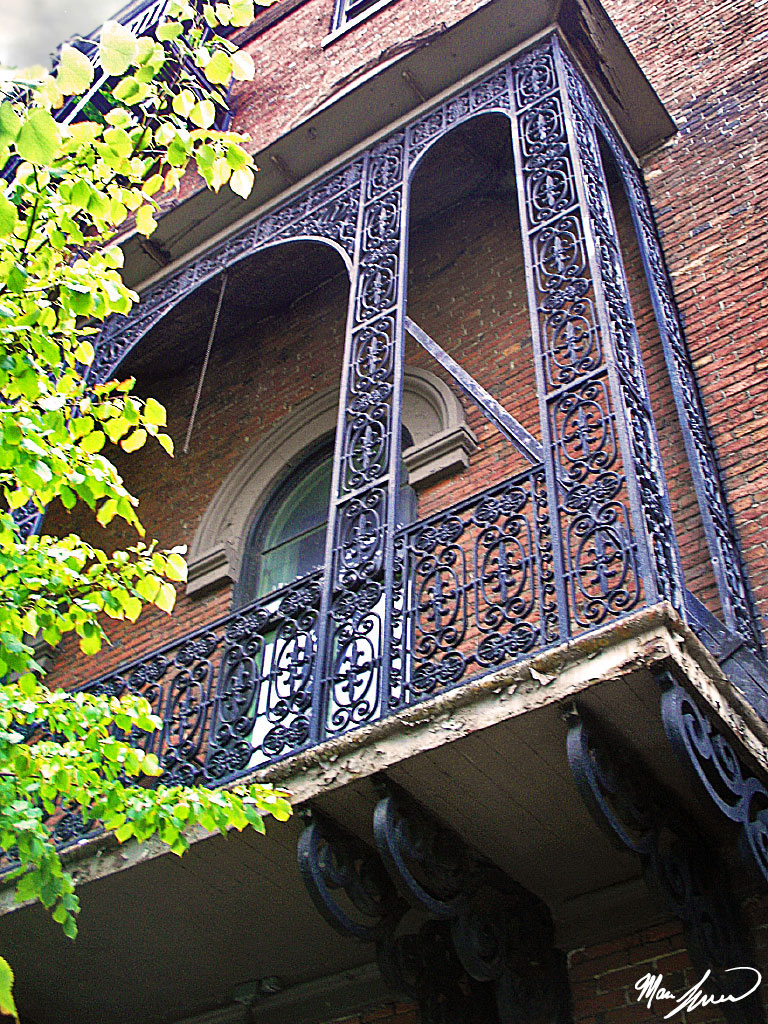
The house follows the typical design we have seen so far of four stories faced in brownstone. The brownstone cladding is only on the principal facade on Cathedral Street; the side facade on Monument has brick with brownstone detailing. The first floor is set apart visually with rusticated masonry, a particularly Renaissance feature; the door has flanking pilasters carved with a cable motif. The excellent ironwork balcony separates the first and second floors. Although ironwork is often associated with the south, it was once much more common on buildings in the north. The Monument St. facade features an exquisite cast-iron balcony with a tent roof, pictured above, designed by Hayward, Bartlett, & Co. Each floor features a different window treatment, much like the Albert house across Monument St; with each floor there is simplification of the ornament as well as the expected reduction in size. The second floor has round arched windows stopped with paneled spandrels and an entablature, while the segmentally arched windows of the third floor keep the rectangular surround but have rosettes in the spandrels and a cornice rather than a full entablature. The fourth floor segmental arched windows have a simple surround, but the way they intersect the architrave of the main cornice gives the cornice the appearance of undulating, an unusual feature. The cornice itself is horizontal with a course of brackets with a course of dentils underneath. I really wish I had a better picture of this interesting house, but alas I have to work with what I've got. If anyone has one, I would be grateful!
.jpg)
Saturday, June 8, 2013
The Francis Bennett House, Baltimore, MD
 |
| The Francis Bennett House, Baltimore, MD. 1857 |


Friday, June 7, 2013
The George Reuling House, Baltimore, MD
 |
| The George Reuling House, Baltimore, MD. 1860 |
The other floors proceed as expected. The facade might be stuccoed or painted; it is hard to tell. The window surrounds of the house are very spare, with plain moldings, brackets, and cornices, as is the main entablature and cornice. Considering it is next door to a rather exuberant house, it might be that Dr. Reuling preferred to create a contrast with restrained ornament. The door has an interesting vestibule, as it is arched and inset into the facade like many Baltimore doors. This image shows that there is a small saucer dome, pendantives, and arched panels in the entryway, a particularly elaborate feature. The glass also seems to be etched. I found an image on Flickr of the house's staircase and hallway that shows many of the architectural details may be intact. Again, Baltimore does not disappoint with a good example of Anglo-Italianate design, so significant to that city.

Thursday, June 6, 2013
The Albert Schumacher (Asbury) House, Baltimore, MD
 |
| The A. Schumacher House, Baltimore, MD. 1855 |
The house's first floor is entirely rusticated, resembling a traditional treatment of the first floors of Italian Renaissance palazzos, and is pierced by arches. It looks to me like the house is stuccoed and scored to resemble stone. The second floor is where things get strange. There is a large balcony separating the first and second floors resting on large brackets with a balustrade of ironwork set in a stone frame, a costly and uncommon treatment. Instead of having the usual three windows, there is only a central bay window intersecting the balcony, with arched windows, a paneled frieze, and a crowning balustrade. This is where the impressive library is. Flanking the arch are stone panels set into the facade with curved, chamfered corners. An almost awkwardly large belt course separates the second and third floors; on the third, there is a return to the three bay scheme. The surrounds are rich, featuring segmental arches, thick eared moldings with panels in the spandrels, and keystones. Above the windows, is again, an awkwardly large space before the cornice, which is of the expected Anglo-Italianate type, horizontal, dentiled, thickly bracketed. Small circular windows pierce the frieze of the cornice, which is in some ways a throwback to Greek Revival designs in which circular windows with wreaths are often found in the frieze. The whole features tall blank pilasters that frame the composition.
It is an odd house. The architects, although some of their spacing is a bit strange looking, accomplished a beautiful and eye-catching design. From the description, I would really like to see some plans and interiors; it sounds as if there are a lot of complex shapes at play inside.
.JPG)

And I thought I would include a picture of the adjoining church (photo by Wally Gobetz).

Wednesday, June 5, 2013
The William H. Graham House, Baltimore, MD
 |
| The William H. Graham House, Baltimore, MD. 1850 Photo: Marc Szarkowski |

These next week of posts will focus on Anglo-Italianate houses in Baltimore! In its Mount Vernon neighborhood, Baltimore developed a surprising collection of high style row houses in a sober and elegant Anglo-Italianate style. Partly, this might have been the influence of European-born architects on the city, partly the city's cosmopolitan nature, and partly the interest of its newly wealthy class and their relationship with Europe. The neighborhood, Mount Vernon, is one of the finest examples of aesthetic urban planning. It is marked by a series of four squares that radiate in a cross out from the central square containing a column that honors George Washington (1829). There was a building boom on the squares in 1850 that transformed a neighborhood of detached houses into a dense enclave of stately rows. At any rate, it is an important set of examples of highly European influenced design in the US.
The Graham house is a landmark at 704 Cathedral Avenue in the Mt. Vernon neighborhood. It was built in 1850. I did not know for whom it was constructed, but fortunately Oleg Panczenko filled me in, which I very much appreciate. He notes in the comments:
"The Graham House was constructed in the 1850s for William Hamilton Graham (1823-1885), director of Alexander Brown and Co. and son-in-law of George Brown (important names in Baltimore’s banking history). Mr Mencken occupied a third-floor apartment with his wife, Sara Haardt (1898-1935), from about August 1930 to March 1936.
After Sarah’s death on May 31, 1935, Mencken wrote to Joseph Hergesheimer (March 19, 1936): “It turned out to be completely unendurable, living in this apartment. It was too full of reminders, and too dreadfully empty and lonely. I am going back to Hollins street with my brother August, and taking Hester [Denby, cook and housekeeper] and Emma [Ball, cook and general domestic] along.”
I won’t recite the tedious chain of title but will make three notes: (1) The Monument Place Apartment Company owned the building from 1918 to 1937. (2) Lawrence d’A.M. Glass purchased the building in 1976. (3) In November 2011, Baltimore City took title to building by condemnation so that it could be used used as an annex to the School for the Arts."
Thank you, Oleg, for the correction!
The house bears a great deal of similarity to the Augustus H. Albert house not far away. Both follow the five bay plan, both are constructed of brownstone, and both draw from the Anglo-Italianate vocabulary for their ornamentation. One interesting thing I notice about both houses is that the central bay is slightly recessed. I have seen this in other row houses, such as the Wing-Williams house; however, it seems to be particularly popular in Baltimore's houses and is found in its Greek Revival architecture, such as that of the Mount Vernon Club (1842) as well as the early Italianate Thomas-Jencks-Gladding house (1851). The recessing of the central façade might have been a particularly popular method of handling a five bay façade in Baltimore. It definitely tries to present a pavilion effect.
The house is not as complex as the Albert house in its variations. Starting from the basement, we have a rusticated base with semi-circular windows covered by grills. These are topped by thick, heavily carved brackets and cornices that probably supported iron balconies, now gone. The window treatment is the same for all the windows; the sides of each molded surround feature inset panels with carved cable decoration, topped by foliated brackets and a cornice with dentil molding. The windows gradually decrease in height with each story, a common feature of row house design. The entablature is horizontal and follows Renaissance precedents in its accurate simplicity, its small thickly spaced brackets, and its deployment of dentils and egg and dart molding. One notable feature is that unlike the Albert house, the entablature on the Graham house does not recess with the façade but runs in an unbroken line. The central bay has doubled windows. The door of the house is particularly fine, copying the window surrounds with an arch in the center with elaborate carved foliage in the spandrels. Baltimore seems to have liked elaborate carving as demonstrated in the Backus house. The door is recessed and the portal has niches on either side. The following enlargements highlight some of the details.


Friday, May 3, 2013
The Augustus H. Albert House, Baltimore, MD
 |
| The Augustus H. Albert House, Baltimore, MD. 1859 |
I said that Baltimore was a great place for Anglo-Italianate row houses and this is a good example even though the house is slightly detached from the surrounding buildings. The Albert house was built in 1859 and was designed by Louis Long, a prolific mid 19th century Baltimore architect. The house was converted in 1867 to be the Mt. Vernon Hotel, a very early conversion of a private home, but it then reverted to a home again in 1902 when the interiors were dramatically redesigned. The house is currently occupied by offices and a club (the linked site also features an interior view). The house follows the five bay plan, a plan which does occur in urban settings but less frequently. The detailing is particularly careful about following Renaissance prototypes, so much so, that the house has an air of being a product of the 1880s rather than the 1860s. The only major flaws in conforming to Renaissance aesthetics are the cornice over the porch, which is far too small, the oddly divided triglyphs in the porch entablature (which project slightly almost like brackets), and the incised lines in the main frieze.
The house is faced in brownstone, or more probably imitation brownstone, because brownstone soon after its popularity spread was found to delaminate or flake over time. Imitations were sought after to prevent this damage to the fabric of a façade. The house is set over a tall, rusticated basement and a slightly recessed central bay divides the house into three sections. The first floor arched windows have thick hood moldings and balconies connecting each pair, while the second floor windows have thinner eared moldings that conform to the segmented arch of the windows with blind balconies (a balustrade placed against a wall). The use of only four balusters seems odd to me, since one usually sees five on such blind balconies. They are also unusually squat and widely spaced and the thickness of the supporting molding and brackets is also very strange but very Italianate. The third floor has simple square, eared moldings. The façade is given unity by the belt courses that divide each floor at the sill as well as the increasing diminution in the height of each window. The porch is a grand affair hovering over the stoop with its paired Tuscan columns, arched doorway, and tall frieze of triglyphs and metopes. Although the house proclaims its Renaissance inspiration and does give somewhat an appearance of a Renaissance palazzo, the individual eccentricities I pointed out make it truly an American Italianate.

Thursday, May 2, 2013
The John Backus House, Baltimore, MD

 |
| The John Backus House, Baltimore, MD. 1855-56 |
The windows as well are surprisingly varied. The first floor has paired arched windows with Austin-like surrounds and carved bosses in the center divider. The second floor on the flanking sections has tripartite windows with a tall center section and surrounds surmounted by carvings. The center section features paired arched windows that differ from the first floor in the depth of the molding and the center pilaster on the divider. The third floor on the sides has deeply recessed plain windows, while the center section in the gable features tripartite round headed windows that lack the surrounding molding but include the bosses and carved toppers. All this makes for a façade that has a dizzying array of irregularity, but nonetheless harmonizes in the careful deployment of different forms on different windows. The door surround is yet another variation, with an ogee arch that extends from the defining belt-course broken by an explosion of elaborate vegetal carving. The door itself is entirely surrounded by side lights. Supported by Corinthian columns, the pendantives feature yet more carving. The amount of vegetation on this house almost makes it seem like the trees that surround it.
The cornice as well displays unique variations. While the parts flanking the gable are relatively simple bracketed cornices, where they engage the gable, which is raised several feet from the cornice, there are odd carvings that look like upside-down tulips. The gable has no bracketing but features a series of thickly spaced Romanesque style drops under a simple cornice. As one might expect in this house, there are further vegetable anthemia (carved floral pieces that top a gable) on top and to the sides of the gable. I provide some detail shots below.


The following pictures from the Historic American Buildings Survey (HABS) show the house without trees obscuring it and some of the interior.

The interior features a beautiful curved staircase, which seems to run around a curved wall.


The parlor displays interesting paneled doors.

The Backus house is one of my favorite buildings in Baltimore. It is a unique piece of architecture that seems to take the indoor world of pier mirrors and rococo furniture outdoors in its beautiful carving.
Subscribe to:
Comments (Atom)