Showing posts with label 1880s. Show all posts

Thursday, February 8, 2018

The Clark J. Whitney House, Detroit MI

The Clark J. Whitney House, Detroit MI. 1857 Photo: Scott Weir

The same house in 1882. Photo: Scott Weir
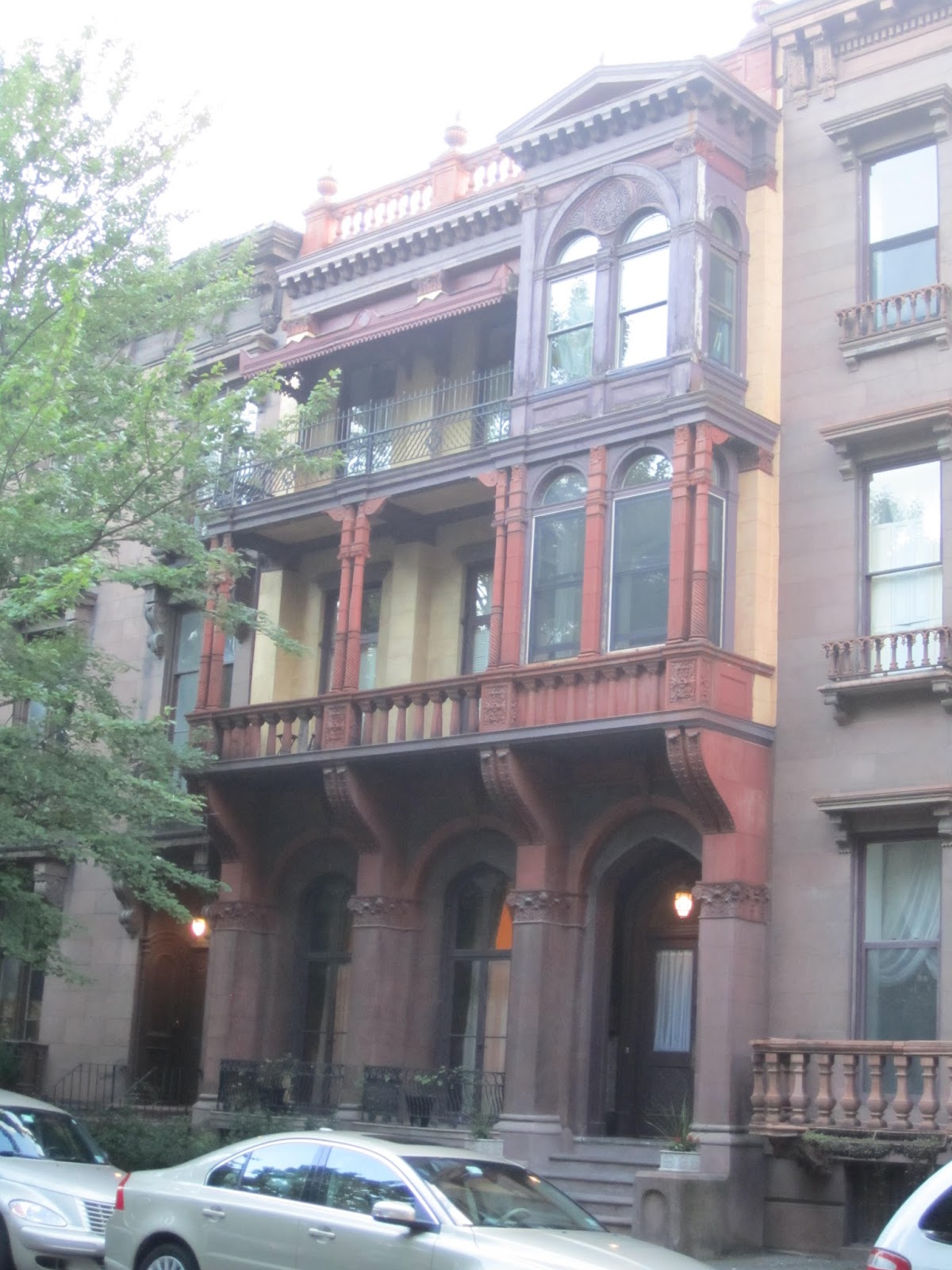
It's rare to see an Italianate remodeled into another Italianate. Typically you slap a mansard roof on top or a Queen Anne gable and call it a day. But that's not what Whitney did with his chaste 1857 house in Detroit. Instead, he took his genteel Italianate and decided to display his new status with a zany new design, doubling the size and basically constructing a new house right into the fabric of the old. The house has a rotated side tower plan. In the 1857 design, the house had a projecting bay with two windows and a typical three stage tower, all ensconced in a lovely arched porch topped by a railing with a guilloche design. The window treatments were simple, with rectangular windows that had rococo iron designs as the hood moldings on the second floor and arched windows on the first floor and tower. The cornice design featured a thick architrave molding with double s scroll brackets (Detroit couldn't get enough of those) all very closely spaced. All in all it was a nice house reflecting the taste of the 50s.


When 1882 rolled around, Whitney had made some money. He was a major purveyor of Detroit's music scene, selling instruments and sheet music. In 1882, he helped rebuild the old opera that had burned and really came into his own. No doubt, the rebuilding of the opera (in a rather refined modern French design) caused him to think about updating his own home. To the fabric of the old house, Whitney started by removing the wrapping porch, replacing the porch on the front two windows with a bracket surround supporting a balcony with a series of segmental arches and hanging drops, a very picturesque touch. Around the door, a rich and complex two story porch was built. The rectangular windows were disguised by segmental arched stone surrounds (oddly, an incised angular line runs through the arch). The center of the entablature on the projecting pavilion was cut (after new c scroll brackets were installed), the roof was raised, and a dormer was added with a segmental arched open pediment. Although the old decoration of the tower was retained, the eave was removed and a new story was attached with a triple arched palladian window, no doubt to compensate for the poor optics of a stubby tower with a steeper roof slope. A rather bizarre and heavy finial crowned the whole. The most drastic change, however, was the addition of basically a second house to the side, designed in the pavilion plan. Unlike the old house, where the windows were only disguised as segmental arched, here they were actually so, and were connected by a string course of stone that distinguished the older from the newer section. The new wing was all about diagonals, with two two story bay windows flanking an equally diagonal lacy porch. One odd feature is the bracket placement on the diagonals of the bay windows, with few brackets there contrasting with the forest in the other sections. 


So, which do you prefer? 1857 or 1882? I'd love to know!

With this, I end my short series on Lost Italianates of Detroit, but will revisit the topic soon.

Saturday, July 16, 2016

Samuel Sloan: Italianate Planner and Architectural Theorist


Woodland Terrace in Philadelphia (1861).
This is Sloan's most impressive surviving architectural ensemble and is
characteristic of his numerous works in West Philadelphia.
Perhaps no other architect worked as hard as Samuel Sloan (1815-1884) to popularize not only the Italianate Style in the US, but also to revolutionize construction, decorative, design, and technological practice for American architects. Sloan, as his writings show, saw himself as a person who could help American architecture develop an inventiveness, creativity, technological prowess, and stylistic vocabulary beyond the mere copying of European precedents and designs. From Sloan's perspective, his role was to help improve American architectural practice (which he did not have the greatest confidence in from his early training) and encourage the development of an intelligent, quality, and independent American architecture.

The best published work on Sloan is Harold N. Cooledge's Samuel Sloan: Architect of Philadelphia 1815-1884 (1986) which not only provides a thorough biography of Sloan's life and career, but also a catalogue of his works. Additionally, Sloan's own voluminous writings give us more insight into his thoughts and architectural ideas and practices than we have for almost any other mid-19th century architect. Born in 1815 in rural Beaver Dam, PA to a family of cabinet makers, Sloan was by 1833 an active builder in Philadelphia. His first recorded work was building some elements of Philadelphia's Eastern State Penitentiary and he moved up the ranks working for well known architects like John Haviland and William Strickland. Soon after, Sloan began producing designs for the opinionated and visionary Thomas Kirkbride, a hospital and mental health theorist, giving Sloan an immense amount of training in institutional design and providing him with a patron who encouraged and transformed him from a carpenter into an architect and designer. Most of the early decade of his career was spent in the background, working on institutional and governmental public buildings, schools, court houses, and hospitals guided by the theories and ideas of powerful and opinionated clients.

Sloan's independent career properly begins in 1850, when he was given the commission to design a villa for Andrew Eastwick, a locomotive manufacturer. This building, which Sloan designed in the "Norman" style, combining Italianate features with north Italian medieval design would gain him architectural renown and introduce him as a unique architect. At exactly the moment Sloan appeared on Philadelphia's architectural stage, the city was expanding, and several developers aimed to construct a model suburban community in West Philadelphia. The selection of Sloan as the principle designer for many of these developments, mostly in Gothic and Italianate styles, meant that he would shape the entire architectural vocabulary of suburban Philadelphia. Even later architects who continued the project followed Sloan's design principles, giving this area of the city a distinctive architectural harmony, disrupted only in the later 19th century by scores of Jacobean, Colonial Revival, and Queen Anne rows. In 1855, Sloan even got to plan and design an enclave of fine villas in Riverton, NJ. Additionally, he became a designer for most pf Philadelphia's public schools, several major commercial buildings, and several speculative residential rows within central Philadelphia.

Sloan's design for the Eastwick House "Bartram Hall".

Between 1851-3, Sloan worked on and published his first major architectural work, The Model Architect. While plan books were plentiful in the 19th century, Sloan's contribution was different. Not only did he provide dozens of plans and elevations, but Sloan also offered several illustrated pages of details, in which he depicted up-close the doors, windows, cornices, brackets and sometimes interiors and furniture choices for architects. A few plans contained full landscape plans, complete with a series of fantastic gazebos, squirrel houses, bird houses, and conservatories, all carefully designed. But Sloan didn't stop as many other designers did, in just offering a superficial set of designs. This book also included theorizing on styles, advice on good joining and construction practices (including complete drawings of the framing of buildings), detailed discussions of heating and cooling mechanisms for homes, a frank discussion of comfort and practical designs, as well as detailed descriptions of cost, construction timelines, and architectural accounting. Sloan provided basically a full tutorial on architectural practice in America. The Model Architect was a revolutionary book and so central to American architecture that copies of it spread across the US. No other architect gained as much exposure as did Sloan, and it's thanks to this book that Sloan's designs ended up all over the US, with thousands of buildings based on his work. Thus, while Sloan had a confined set of commissions he personally worked on, his designs spread far beyond his personal reach, stamping his legacy on dozens of towns. The book was so popular it was reprinted every decade until the 1880s. Below are examples of Sloan's detail pages as well as his designs for non-architectural members, such as birdhouses (an Italianate birdhouse!).


From 1852-8, Sloan formed a partnership with builder John Stewart. In this period, Sloan came up with one of his most original designs, the Bennett & Co. building, a fantastic commercial edifice in the Norman/Gothic style. He also designed the Second Masonic Temple in Philadelphia, a fantasy of lacy Gothic, in 1855. Joseph Harrison as well in this period commissioned Sloan to design his planned communities in West Philadelphia as well as his palatial estate on Rittenhouse Square (1856). Unfortunately, this period of prosperity came to an end in 1857, when Sloan and Stewart dissolved their partnership after a major financial panic. In 1858, Sloan published his second work, City and Suburban Architecture, which offered a wider range of designs ranging from commercial, civic, religious, to residential. In it, Sloan focused on the difficulties of designing buildings appropriate to sites and for different functions. The book has numerous beautiful drawings, more polished than his earlier work, which the draftsman Addison Hutton contributed. As Sloan's career matured, so did his architectural approach, and in CSA, we can see a far more austere and sophisticated approach to European style Renaissance ornament.

In 1859, Sloan was to begin work on his most famous building, the octagonal oriental villa "Longwood" in Natchez MS. Based on one of his plans from The Model Architect, seen by Haller Nuttit, the owner of Longwood, it would consume many bodies from Sloan's office until 1860, when the outbreak of the Civil War convinced the northern workmen to return to Philadelphia. The house would remain, its exterior complete but its interiors unfinished. As work tapered off during the Civil War, Sloan published two more books. Sloan's Homestead Architecture and American Houses: A Variety of Designs for Rural Buildings (both 1861), both of which recycled material but also explored the concept of well-designed affordable housing. In this period as well, Sloan designed Woodland Terrace in Philadelphia, his most significant surviving ensemble. The contentious city hall competition in Philadelphia coupled with the war meant that Sloan's work slowed during the 1860s, when Sloan was partnered with Addison Hutton (1860-8), during which he focused on designing hospitals and courthouses. In one case, the increasingly cantankerous Sloan sued the town of Williamsport for stealing his plans for their courthouse. Additionally, he began publishing editorials criticizing the narrow stylistic stubbornness of architects whom Sloan saw as ignoring their client's wishes in favor of abstract devotion to European stylistic canons. For Sloan, American architecture did not need to be so prescriptive; it should revolve around practical requirements, convenience, comfort, and fitness, more than abstract theories about the moral and ethical implications of style.

"Longwood" Photo: Wikimedia.
Sloan joined the American Institute of Architects in 1868 and founded the periodical The Architectural Review and American Builder's Journal which served as a vehicle for his ideas and plans until it folded in 1870. In this periodical, Sloan took to task the architects (calling them in his first essay "mere constructors") with whom he disagreed, earning him many enemies and critics, but the periodical did allow architects from outside the east to display work and promoted the formation of the AIA. As Sloan alienated Philadelphia society and architects, his interests began to turn elsewhere outside of Pennsylvania. His involvement in the renovations to the NJ state capitol resulted in a very different appearance for the architecturally confused building. With little work coming in from Philadelphia, Sloan received commissions for public buildings in North Carolina, which encouraged him to move his office to Raleigh in 1877. In this period Sloan changed with the styles, and his design for the NC governor's mansion is an essay in fanciful Queen Anne. Sloan died in 1884 from "typhoid fever" according to several conflicting accounts, leaving behind not only hundreds of buildings he directly designed, but thousands based on his plans, as well as a robust and transformative philosophy that would help professionalize American architectural practice, even if Sloan often fell short of the strict standards he advocated.

Sloan on the "Italian Style"

Sloan worked in three principles styles, Italianate, Gothic, and Oriental/Italianate, but the majority of his works can be classified as Italianate in spirit and in principle. In Sloan's writings, he identified four different styles that I would classify within the realm of Italianate design, "Italian", the typical Italianate style we have explored; "Norman", a heavier castellated kind of Italianate based on Medieval Italian architecture and German Rundbogenstil; "Bracketed", a less formal form of design with larger brackets and eaves; and "Oriental", which is basically Italianate designs with applied Indian ornament (as I have discussed as Indian Italianate). Sloan's inventiveness, creativity, and focus on convenience, comfort, and fitness over rigorous stylistic canons, as well as the modifications many of his designs underwent in the hands of builders, means that his approach has a smaller degree of unity than many other architects.

For Sloan, the Italian style was primarily an appropriately suburban idiom. He explains in MA that the style is "so well adapted is it to the wants and tastes of our people, that it is likely to become, if it is not already, one of our most fashionable styles for country residences. It possesses very little of the rural character, and seems much more appropriate for the retired home of one accustomed to city life, than for one born and bred in the country. Its location, consequently, should not be in the depths of the forest, but within a few miles of the city." Sloan similarly wrote, like other architects, that while classical Greek and Roman ideas were suitable for public buildings, it was Italian design that suited domestic design. In defining the style, Sloan zeroed in on irregularity as its primary feature: "Most generally, Italian villas have an irregular outline from every point of view. The predominant figure is the rectangle, but many being introduced and so disposed as to break in upon each other, the irregular outline is formed without difficulty. The angular effect is relieved by the semi-circular arch which is freely used. Great license is also permitted in the ground plans, thus admitting almost every possible arrangement of apartments." He also noted the significance of towers, or "campaniles" as he terms them. Additionally:

"It has been stated that gables do not occur, but this is incorrect: we simply cite Raphael's villa, in the Borghese Gardens. Hip roofs are, however, common. In all cases the eaves are heavy and projecting, being supported by brackets and cantalivers of various patterns. The chimneys are prominent, and serve to give greater variety to the outline. The windows are made double, or treble, and, together with the doors, have either square or arched beads, according to the importance of their position. Bay-windows are frequent. All window and door dressings are made very heavy, and, indeed, throughout there is a tendency rather to boldness than minute decoration. Heavy arcades, porches with large square pillars, verandahs, balconies, anta?, pilasters, quoins, rustic work, and string courses, all often occur."

"The character of this style is far from being rural, but is genuinely picturesque. The irregularity of the ground plans and vertical outline, and the great freedom allowed in general design, give considerable room for the exercise of taste. In Italy, the surface of the country is greatly diversified by hills and valleys, and advantage is taken of this in erecting the villas so as to command landscapes."

For Sloan, Italianate was a style perfectly suited to his belief in function over form and in his suburban ideal, both his ideal for the concept of the suburb as rus in urbe as well as his ideal of the suburban inhabitant: "Country residences in the Italian style are becoming more and more popular, both here and in the old world. Its great pliability of design, its facile adaptation to our wants and habits, together with its finished, elegant, and picturesque appearance, give it precedence over every other. It speaks of the inhabitant as a man of wealth, who wishes in a quiet way to enjoy his wealth. It speaks of him as a person of educated and refined tastes, who can appreciate the beautiful both in art and nature ; who, accustomed to all the ease and luxury of a city life, is now enjoying the more pure and elevating pleasures of the country."

Norman architecture for Sloan was as much an ornamental style as a conceptual mode. He traced its origins to the barbarians who invaded Italy and adapted architecture for their own needs, creating the style we would now call Romanesque, upon which Italianate design was based. Sloan characterizes this style throughout as massive and suited primarily to public buildings. For residences, he advised caution and attention to scale: "For dwellings, this style is only adapted to those on a large scale. Its heavy, bold, and rich expression would be lost in a building of small size, but for an extensive villa it presents most admirable features."

As for the Oriental style, Sloan considered its application to housing to be a matter of decoration and not design. In essence, he created an Italianate plan and plastered on Oriental ornament: "It would be sheer folly to introduce the original pure style into this country, for no wise man will sacrifice his comfort in order to secure consistency in the appearance of his house with those which have been built in other countries, in other climates, and perhaps for other purposes by people with different customs. Our style of living is totally unlike that in the East, and were we to build just such houses as they have, we would certainly part with comfort. This last is of the first importance. Let every one arrange his dwelling so as to secure the greatest amount of convenience, and then exercise his judgment in decoration. We hold that, in a manner, each building is an independent being, and if it be consistent with itself both internally and externally, and as to its purpose, then no fault can be found with it on that score. Many buildings similar to the one here given have been erected in this country and command universal admiration. The best location would be on the banks of some of our noble streams, the Mississippi or the Hudson."

As for the Bracketed style, Sloan considered it a subset of Italianate design in which the eaves were oversized: "In sunny climes, it is highly desirable that the walls of dwellings, especially, should be protected, as much as possible, from direct rays. This fact has given rise, in Italy, to a style in which the eaves of the building project considerably. This projection is often so great, that unless there be some apparent support for the eaves, the eye is offended by a sense of insecurity. The defect is remedied by the use of cantilevers and brackets; whence the name bracketed style, in use among some authors. The style is growing among us, and deserves high commendation, for country residences especially, since, in addition to cooling shade, it gives many other pleasing effects."

Thus, for Sloan, Italianate remained the bedrock of planning. Most of his designs maintain the irregularity and convenience of the Italianate style which was suited for his ideological beliefs about residential and architectural design. The Norman and Oriental styles consisted mostly of an ornamental idiom applied to the convenience of Italianate design, and that idiom in his plans always remains an intriguing dress over the consistent Italianate features of irregular or convenient planning, brackets, towers, and large eaves.


In the next series of posts, I will look at all of Sloan's direct architectural work as well as provide a survey of all of his Italianate plans from his publications to give a full impression of his influence on the style. Additionally, where I have found them, I'll provide examples built from his plans to show how his theoretical work influenced designs throughout the US.

Like this post on an architect? Check out the posts on John Notman!

Monday, May 9, 2016

The Nathaniel Wilson House, East Millstone, NJ

The N. Wilson House, East Millstone, NJ. 1888 Photo: Wikimedia
This somewhat strange house was built by Nathaniel Wilson, a hardware store owner, in the small town of East Millstone in 1888, yet the elaborateness of the design makes this house far too sophisticated for such a rural area. No doubt that was Wilson's plan, to show off his own success in front of his neighbors with their more modest homes. Additionally, 1888 is a very late date for building an Italianate house, especially one like this which is fully invested in the design principles associated with the 1870s, yet here we are. Maybe Mr. Wilson just stopped evolving with the fashions after 1875. The house's plan is a little tricky, is it a side hall plan with a wing, or an irregular plan without a tower or fully projecting pavilion. I actually go with the latter primarily because of the brickwork. The facade of the house uses the brickwork to create a series of recessed planes with angled bricks that form a row of dentils at the top that mark the bays and frame architectural units. If you look carefully, the right two bays are marked by one plane as are the left two recessed bays. The central bay is marked by another, where the tower should be, indicating the designer was thinking in terms of the irregular plan, even if they didn't reproduce the volumes.

The details on this house are rather intriguing. The first floor windows are segmental arched, the second rectangular, a slight variation from the usual interplay of shapes. The subdued label stone moldings are spare with bulls eyes and carved keystones, echoing patterns one sees on late 19th century Eastlake interior woodwork. The two main carved features are the porch and cornice. The porch which wraps around the house is a rather clunky arrangement of disparate artistic forms. Fussy posts with too many molded sections support an entablature that consists of an open arch with drops on the first stage, a row of pierced circles on the second, and strange boards on the third which have blind quarter arches with keystones and incised Eastlake carving in the spandrels. It seems the designer, instead of relying on any precedents, decided to construct an entablature from various random sections from a catalogue, transforming classical design into a series of superimposed decorative bands. The cornice as well is very strange. It's elaborately paneled in its frieze, with a run of dentils, then another band of panels above. The brackets, which are s scroll type, are elongated. It is in their placement that we can see the influence of the irregular conception. Unlike most Italianates, this house has an uneven and irregular placement for the brackets, with different spacings between the groupings. Around the tower section, for instance, we have two tightly placed brackets in a pair to the left while to the right are three tightly placed brackets, behaving as they would if there really were a projecting tower. Similarly to the right of the projecting facade, we have one widely spaced bracket and then a tightly placed pair, basically filling the space on the cornice with as many brackets as possible. It's very strange. As you can see on the side facade, there is a bizarre projection over the box window which takes the form of a mansard roof in section with decorated barge boards. But stranger is that the architect decided instead of treating it as a mansard roof proper, to run the cornice design onto it, causing to to grow inorganically out of the facade.

Overall, the Wilson house is a great example of someone who let their desire to impress with carving and woodwork get in the way of adhering to harmonious principles. But despite awkwardness, the house achieves its purpose in appearing grand and expensive, and is overall a successful stylistic muddle.


Sunday, May 1, 2016

The Jesse H. McVeigh House, Hannibal, MO

The Jesse McVeigh House, Hannibal, MO. 1885 Photo: Brandon Bartoszek
Photo: Amanda Baird/BlackDoll Photography
The Jesse McVeigh house, built in 1885 for a member of one of the major families of Hannibal, is one of the most photographed homes in town, certainly due to its beautiful state of preservation, eye catching features, and attractive paint scheme, even if the painting is a little inaccurate for the period. The house follows the rotated side tower plan (of course this example is towerless, though the side tower mass is expressed by the right hand bay), which in essence is an irregular plan with the short side facade facing the street as the principal expression of the house. The home has a typical steep hip roof that nearly every Hannibal house has and is enlivened by beautiful detailing. The segmental arched windows have elaborate label hood moldings with fanciful, impossibly un-classical brackets, thick keystones, and Eastlake incised designs. A bay window on the front continues the general design. The cornice has a simple architrave molding with small entablature windows, a run of dentils, and elaborate s scroll brackets. Perhaps most impressive, though, is the abundance of porches, with elaborate paneled post supports that form shouldered arches. On the right, the porch has two stories (though the upper porch might be slightly later), while on the left, the porch gracefully curves out and projects an entire bay from the facade, a very uncommon feature, as side porches usually are far more closely attached to the facade. This is perhaps an influence of the porch mania and inventiveness of contemporary Queen Anne design that gives unlimited scope for non-traditional porch possibilities. It does create an awkward join between porch and facade, but nonetheless creates a beautiful open space around the entrance.

The plan must have been popular. It seems that John Mounce beat the McVeighs in introducing this plan in his house at 207 N Maple in 1880. The Mounce house is basically identical (without the second story porch addition) although the second story windows are joined rather than separated as in the McVeigh house.

Mounce House, 1880 Photo: Mike Steele
Photo: Amanda Baird/BlackDoll Photography

Friday, April 29, 2016

The Edward M. Holmes House, Hannibal, MO

The Edward M. Holmes House, Hannibal, MO. 1885
Photo: Amanda Baird/BlackDoll Photography
The Edward M. Holmes house was clearly very impressive, but is currently in need of some TLC for sure. The house was built in 1885 for Edward Holmes, a cigar manufacturer, and went through a succession of owners. On a corner lot, the house presents two finished facades. The front has a typical side hall design of three bays, while the side facade has a strong projecting central pavilion, gabled, with a two story bay window. The side originally had two porches with tent roofs, but one has been filled in while the other after this photo was demolished and replaced by a mudroom (unfortunately). The front of the house features the most elaborate features, with cast iron window hood moldings with bulls eyes. The thick cornice has several layers of moldings with a thick run of smaller brackets and an odd number of long brackets. Long brackets usually divide bays, so there should be four pairs, but this facade has only three. Finally, the most impressive feature is the intact bracket surround around the front door with an overly thick molding, tent roof, and one massive c scroll bracket that runs the height of the door, which seems to feature large expanses of glass. Throughout are Eastlake incised carvings. I think this house suffers most from a sorely needed coat of paint; a little restoration and it would look fantastic.


Thursday, March 10, 2016

The Connors-Boland House, Troy, NY

The Connors-Boland House, Troy, NY. 1880
At 216 Third Street, this house was built by a speculator in 1880 and was subsequently occupied by the Connors, who manufactured paint, and is currently owned by the Bolands. Unlike many of the other houses on Washington Park, it is faced with brick with brownstone details. It follows the typical side hall row house plan. This house is covered with Eastlake incised carving, with segmental arched hood moldings with guttae (little triangles at the bottom of a Doric triglyph) and incised foliage. The box window over the front door similarly has a combination of Eastlake and Gothic ornament. Perhaps the coolest thing about this house is its cornice. The frieze of the cornice is formed by an arcade of blind arches with tiny Gothic columns supporting them with small brackets above.

Monday, February 29, 2016

The Francis House, Troy, NY

The Francis House, Troy, NY. 1846.
This is perhaps the most fantastical house on the square. It was built for Hiram Slocum in 1846, but is named after the Francis family who purchased it in 1866 and remodeled the front in the 1880s. The remodel, or remuddle, no doubt altered what was a typical brownstone, Anglo-Italianate, row house plan structure into a cascade of balconies, overhangs, and an impressive Italianate box window. The pilasters on the first floor suggest there may have originally been pilasters supporting three arched openings with molded surrounds. The second floor probably had a box window with simple surrounds. It's been said the Francis family traveled frequently to Europe, and this might explain their desire to jazz up the house and make it even more Italian with multiple balconies, made of thin columns and an impressive metal, fringed awning. I particularly like how nicely handled the third floor box window is with its Venetian tracery, close packed brackets, and delicate metalwork appliques. The balustrade at the top completes the house's European pretentions.

Monday, January 18, 2016

The Lanaux House, New Orleans, LA

The Lanaux House, New Orleans, LA, 1884


The Lanaux House, built for the family whose daughter inherited the nearby Johnson house is a late Italianate built in 1884, designed by James Freret, a significant Louisiana architect. Plan-wise, the house is somewhat of a conundrum. It takes as its base the typical side hall plan that follows the Porch Facade type, but completely obscures the rectangular design with the diagonal tower on the left, which houses the main entrance and features elongated windows, and another diagonal box window projection on the right, leaving only one flat surface on the front. This gives the house an interesting undulating appearance which requires adjustments to the porches so that they connect to the projections. Unlike the brick and plaster houses we have seen on Esplanade Avenue, this home is faced in clapboard. It also features a tall hip roof that accommodates a French style dormer window. Later than the other Greek Revival designs, the house has an expected Corinthian columned porch on the second floor, while the first floor has segmental arches with keystones, clunky brackets, and incised Eastlake carving in the spandrels, supported by Corinthian columns. The segmental arch is reflected in all the first floor windows and entrances around the house. The sides of this house are excessively plain, but the paneled cornice runs around the entire house, forming a clear cap on the facade with thick s-scroll brackets. I find the plan interesting, since it invites one into the house as if it's enfolding a visitor as well as the emphasis placed on the large central windows. The house is now the Melrose Mansion bed-and-breakfast, and a visit to their site offers several views of the modernized interior.

Monday, January 13, 2014

The Susan Sturges House, Mansfield, OH

The Susan Sturges House, Mansfield, OH. 1880 Photo: Wikimedia
The Susan Sturges House (NRHP) in Mansfield is located at 317 Park Ave. in Mansfield and was occupied by Sturges, an important local philanthropist. It is a late wooden Italianate from c. 1880, but the home appears to embody the style of the 1860s and 70s rather than the stripped down version of Italianate seen in the 80s. The house follows the rotated side tower plan with a long bay on the left side of the front and a short bay on the right side, giving the front an asymmetrical appearance. The two story front porch, an unusual feature, may be a later addition to the house; it certainly suggests more southern precedents. If it is later, it was designed to harmonize in a simplified form with the more elaborate side porch seen in the back. The house has simple eared, pedimented window surrounds that suggest Greek Revival style, but these are enlivened by keystones with incised Eastlake carving. The brackets are simple s-curve types, and the cornice includes elliptical panels and windows, a feature commonly seen in earlier decades. The feature I like most about the house is the fantastic wooden awning highlighted in the photograph below. Unlike the commonly seen forms with a half hip roof that slopes, this one has a triangular gable the curves and is enlivened by wooden gingerbread. This is a truly delightful feature!

Thursday, August 15, 2013

The Columbia Club, Indianapolis, IN

The Columbia Club, Indianapolis, IN. 1889
Photo from Indianapolis Illustrated
The Columbia Club building was located on Monument Circle in Indianapolis. Though not strictly a residential building, it has a residential styling that is unique. According to Historic Indianapolis it was erected in 1889 and replaced in 1898, after only a few years. It's not surprising that this resembles a house; clubs like the Union League in Philadelphia often emulated residential design, perhaps because so many of them were headquartered in former mansions. Although the building may have been built in 1889, its styling looks more like a product of the late 1870s or early 1880s. This retardaire design might be a testament to the conservativism of the club members and their aesthetics. Even so, the design is grand and dripping with exuberance. The club did not follow a typical plan, although it resembles a side hall house. The first floor is set off from the second by rustication or deep grooves between stonework. In addition the first and fourth bays are differentiated by slight projections and pilasters, making it seem more palace like than might be expected and giving it a European flair. While the first floor is somewhat soberly designed with its arched windows, the second floor is a fabulously ornamented design with segmental arched windows with eared moldings that have cornices above them with carved ornament overflowing above and below to suggest brackets and pediment. Further carved classical panels of swirling acanthus leaves above and below the windows give the club an added Renaissance flair, as do the Corinthian pilasters, also with carved ornament. The cornice is Anglo-Italianate in design with typic rotated s-curve brackets. Although the Renaissance stylings and cornice do suggest Anglo-Italianate, the lack of sobriety in design makes it less of a rigid example of the style. There appears to be a side porch of two stories, with pilasters and arched windows. There is bunting crisscrossing the facade, no doubt for some signifigant event, probably political. Overall an impressive and unique clubhouse for the 19th century man.

Sunday, August 11, 2013

The Hart-Root House, Middletown, CT

The Hart-Root House, Middletown, CT. 1880 Wikimedia
This house follows as well the rotated side tower plan seen at 281 High Street. It was built in 1880 and was inhabited by the Hart and Root families; it's currently a faculty residence. The house has undergone some changes in its career, with its tower being lopped off at some point (I'm sure it followed the usual plan of three arched windows). Still the richness of detail can be seen in it, and it seems to have many features in common stylistically with the Coite house, notably its panel cornice with bull's eyes intersecting the panels. Features I like about this house are the closely paired brackets in the gable front, a feature that gives the cornice a lot of volume. Although the window surrounds are simple, they jibe with the subdued ornateness, and the arched window next to the door is a strange feature, which I am not sure is original. As for the odd box window that juts out into the porch, I have no idea how old it is. It does seem to be integrated into the porch's composition with the pediment, but the design is very 1890s Queen Anne. It could be a clever modern piece. Still, if it can fool the viewer, it's doing its job.

Monday, July 29, 2013

The George R. Fairbanks House, Fernandina Beach, FL

The George Fairbanks House, Fernandina Beach, FL. 1885 Wikimedia


The Fairbanks house is a late Italianate, built in 1885, very late in the career of this style. Apparently, George built it for his wife as a surprise and she was not amused. Perhaps it was because he had built her a house 5 years out of date stylistically (she could never have her 'artistic home' she read about in contemporary publications), or perhaps nothing pleased Mrs. Faribanks (Victorian women could be a bit high strung). At any rate, the house is currently a bed and breakfast; check out their website. There are some good interior photos, which show how the interior is an odd mishmash of Renaissance Revival, Queen Ann, and even Arts and Crafts elements.

The house is an irregular plan Italianate, a plan which had by this time gotten a lot of mileage. In this case, the projecting pavilion is flush with the tower, although a board defines the tower from the pavilion, keeping the elements in their place. Stylistically, the house actually looks like it was built in the 1850s. It is sided in wood, and the ornamentation is kept to a minimum. The cornice is simple, with plan brackets and an architrave molding. The windows have simple moldings, although the balcony attached to the double tombstone window is a neat flourish. The pediments on the doubled windows on the left side is also a bit of spice. The porch has heavy, very Italian looking arches framed by pilasters. At the entrance, the arches form a triple arched Palladian window, a very American feature. Even the side porch incorporates the Palladian motif. It seems very appropriate to Florida to emphasize porches and balconies; at the beach everyone wants to be outside. Unlike the usual triple windows, the tower top has quadruple arched windows, no doubt to allow a better panorama. Although the house is Italianate, it has not escape the influence of Queen Ann. The box window over the entrance, especially the type of windows it has with heavy dividers, are very Queen Ann in style, as are the railings and the elaborate brickwork on the chimney. The double height box windows at the sides also smack of Queen Ann, and look more like San Francisco architecture than that of the East Coast. I suppose though that they participate in the eccentricity of shore architecture. A cute feature is the little dormer window in the hip roof. If someone built this for me, I wouldn't complain!

Friday, July 26, 2013

The Benjamin Franklin Webster House, Portsmouth, NH

Benjamin Franklin Webster House, Portsmouth, NH. 1880 Photo: Patti Gravel


Benjamin Franklin Webster was a prominent builder in Portsmouth, NH, a city famous for its colonial architecture, who was responsible for many Victorian buildings in the area. This impressive structure is his own house that he designed for himself and his wife in 1880. The house is well preserved and is owned by a funeral home that is committed to preserving the beauty of the home (kudos to them!). The house follows the irregular plan, an appropriate choice for a house built on such a grand scale. The plan is not exactly followed, since the recessed wing has one extra bay than usual, and the tower is far higher than usual. The skill of Webster can be seen, however, in that the lengthening of the facade is balanced out by the heightening of the tower. Overall, the house is flushboarded, an impressive treatment for an entire facade.

The late date is no doubt responsible for some of the elaboration of details, which strongly reflect the designs of the 1870s. Everywhere on the house, the careful thought of an architect is evident in the fine and sometimes unique details. The window hood moldings have pediments on shelves supported by carved brackets with a strip of dentil molding. The pediments alternate between simple triangular ones and round ones which are broken by a keystone. An unusual feature is that beneath the porch, the windows have no moldings, but instead have long brackets helping to support the roof, an interesting and no doubt practical feature. The corners of the house have wooden quoins. The porch itself, supported on a lovely stone and wood base, has arched openings, somewhat odd Corinthian capitals, and brackets. It bows around the Renaissance Revival front door at the base of the tower. The cornice has the unique feature of having groups of triple brackets, with a long bracket flanked by two smaller ones. Dentils and a frieze of rosettes enliven the design.

The tower is a particularly beautiful design. It has pairs of windows going all the way to the top, eschewing the expected arched windows or triple windows on the stop stage that are usually found. The treatment of the paired windows is elaborate, with pilasters and wooden fringe defining them. Above the third stage of the tower, it transitions from being a square to an octagon with chamfered corners. This is handled with beautiful curved scrollwork that responds to the shape's transition. The octagonal top stage has windows on four sides with the intervening sides blind with arched panels. The whole is topped with an elegant balustrade. In every way, the home is fantastically preserved, and shows the careful thoughts of a designer rather than a builder.

 The bracketed windows under the porch.

Friday, July 5, 2013

Amos N. Beckwith House, Providence, RI

The Amos N. Beckwith House, Providence, RI. 1861


Here is a good example of a non-sober Italianate in Providence that dared to break with the symmetrical cube shape and materials that characterized other Providence homes. This house is also expansive, receding back further and further. Much of it might be later additions. The house was built in 1861 for Amos Beckwith by Alpheus Morse, Providence's premier Italianate architect. There were enlargements in 1867, and in 1880 some Colonial Revival details were added. When built, it was in the countryside, but now it is in a tightly packed neighborhood of lovely late 19th century homes. The house follows the irregular plan with some variations. The projecting pavilion in this house does not project as far as the tower does, so the house has a rather aggressive forward thrust. I also believe that a porch has been filled in adjoining the tower. It is constructed of wood as well, rather than the usual brick and brownstone.

This house is mostly about the tower. The wall treatment is actually very simple with windows that have simple moldings and surrounds. The cornice is also rather plain with small brackets. The tower however is highly ornamented, with each stage separated by some kind of molding. The first two stories where the tower intersects the house are covered with recessed panels, an unusual feature. The porch is paneled as well with Corinthian columns and a filleted corner arch. At the cornice line of the house, the panels are augmented by large balconies that projet on brackets ornamented with wreaths and ribbons. The third stage has segmental arched windows set into a rectangular frame, and the fourth stage has the triple arched windows so characteristic of the Italianate tower.

The sides of the house are bizarrely long. It's as if the Beckwiths couldn't get enough space in the house and kept crazily adding on. The house features all types of bay windows, box windows, even Colonial Revival Palladians on the sides. One very interesting feature of the house are the dormers on the sides. What's unique is that the dormer windows intersect the cornice and they are supported on large brackets, a design scheme I haven't really seen much. As a final note, I really like the coloring of this house, although people find it drab. This is Downing scheme at work here: the earthy tones, the dark trim, the picked out detail. The house seems much more period appropriate for its proper painting scheme. The Beckwith house is one of Providence's zaniest Italianates, to be sure.


Tuesday, May 28, 2013

101 Westminster St, Springfield, MA

101 Westminster St, Springfield, MA. 1880s?


This house on Westminster Street in Springfield is a part of the neighborhood along Bay Street that is experiencing some major rehabilitation. This house particularly caught my eye because of its period appropriate paint scheme of straw and green. The house follows the symmetrical plan, has a hipped roof with a large cupola that has a somewhat steeper pitched roof. The cornice is of the paneled type with paired brackets and dentils. The house features a porch that crosses the front façade,  with a simple decorative motif and elongated brackets. The bay windows on the side look like they are later additions, probably from the 1890s or early 1900s. I do not know this house's age, as I don't know the age of many of the homes in Springfield. Unfortunately, every house isn't labeled with a plaque with information. Real estate listings (the house was rehabilitated beautifully and auctioned in 2011) say it was built in 1901, but that is far too late for a building of this type. The simplicity of much of the decoration, the fact it lies in a primarily Queen Ann neighborhood, and the Queen Ann front door and elaborate chimney tell me that it might be a product of the 1880s or very late 1870s. Italianates, as we have seen, were still being built that late, although decoration was simplified in accordance with changing tastes, especially after the exuberance of the 1870s. It could also be an older house that was remodeled. At any rate that's my guess (there will be a lot of guessing with Springfield). If anyone does have some information about it, please let me know!

I wanted to post a picture of this interesting Queen Ann, also on Westminster, to give you an idea of the surrounding houses. It has been beautifully restored.

Wednesday, May 15, 2013

La Palistina: The John C. Blanchard House, Ionia, MI

The John C. Blanchard House, Ionia, MI. 1880 Photo: Wikimedia
Although I have never been to Ionia, MI, I came across its National Register listings and was impressed by some of its Italianate architecture, so I am featuring a few buildings from this town. The John C. Blanchard house was built in 1880, one of the latest Italianates I have posted. Blanchard was an important attorney and politician in Ionia, who owned a sandstone quarry, and built this house as he and his wife's retirement home according to the house's website (it is now a museum and rental space). That website also has several interior views. The house was named La Palistina, a Spanish name that means 'delightful'. The style of the house was already going out of fashion in the 1880s to be replaced by Queen Anne and Colonial Revival. Considering the couple was in their 50s however, the conservativism of the design is understandable.

Although built late in the career of Italianate architecture, the house has a strong link with the style of the 1870s, which was no doubt when it was designed. The house follows the irregular plan. There is no tower or tower projection, an often found alternative to the traditional plan. The projecting pavilion is mostly consumed by a two story bay window. The alternation between single windows on the projection and double windows on the recessed section provide a pleasant alteration of forms. The filleted windows and elaborate hood moldings with their broken arch design, as we have seen, are typical of the period. The cornice is undulating and is along with the porch one of the few house features made of wood. The brackets moreover, are complex comprising two s-scrolls, long bases, and turned finials that give the appearance of hanging icicles. Dramatically, the house and exterior decorations, from basement to cornice, are primarily crafted out of a unique local sandstone, giving the house a colorful, variegated appearance that is particularly appealing. Since Blanchard owned the sandstone quarry, he must have had a personal stake in the stone's selection and finish. This more than anything makes the house a special specimen. Also typical of the period is the more steeply pitched hip roof and the iron cresting that tops the composition. The stairway has a particularly grand treatment with sandstone balusters and newel posts that have attached lights. Below is a closer view of the cornice and window treatments.