Wednesday, May 15, 2013

La Palistina: The John C. Blanchard House, Ionia, MI

The John C. Blanchard House, Ionia, MI. 1880 Photo: Wikimedia
Although I have never been to Ionia, MI, I came across its National Register listings and was impressed by some of its Italianate architecture, so I am featuring a few buildings from this town. The John C. Blanchard house was built in 1880, one of the latest Italianates I have posted. Blanchard was an important attorney and politician in Ionia, who owned a sandstone quarry, and built this house as he and his wife's retirement home according to the house's website (it is now a museum and rental space). That website also has several interior views. The house was named La Palistina, a Spanish name that means 'delightful'. The style of the house was already going out of fashion in the 1880s to be replaced by Queen Anne and Colonial Revival. Considering the couple was in their 50s however, the conservativism of the design is understandable.

Although built late in the career of Italianate architecture, the house has a strong link with the style of the 1870s, which was no doubt when it was designed. The house follows the irregular plan. There is no tower or tower projection, an often found alternative to the traditional plan. The projecting pavilion is mostly consumed by a two story bay window. The alternation between single windows on the projection and double windows on the recessed section provide a pleasant alteration of forms. The filleted windows and elaborate hood moldings with their broken arch design, as we have seen, are typical of the period. The cornice is undulating and is along with the porch one of the few house features made of wood. The brackets moreover, are complex comprising two s-scrolls, long bases, and turned finials that give the appearance of hanging icicles. Dramatically, the house and exterior decorations, from basement to cornice, are primarily crafted out of a unique local sandstone, giving the house a colorful, variegated appearance that is particularly appealing. Since Blanchard owned the sandstone quarry, he must have had a personal stake in the stone's selection and finish. This more than anything makes the house a special specimen. Also typical of the period is the more steeply pitched hip roof and the iron cresting that tops the composition. The stairway has a particularly grand treatment with sandstone balusters and newel posts that have attached lights. Below is a closer view of the cornice and window treatments.

Monday, May 13, 2013

The John Wenham House, Grand Rapids, MI

The John Wenham House, Grand Rapids, MI. 1874/76

I was kindly given permission to use the photo above by Doug Copeland, who has taken some stunning architectural photographs; you should definitely check out his photo threads. This is the John Wenham house at 222 Fountain St. in the Heritage Hill historic district in Grand Rapids. It was operated as the Fountain Hill Bed and Breakfast, but that business seems to have been closed. A pdf about the street says the house was built in 1876, although another article says 1874. According to the same pdf, the house has the identical layout to this house in Muskegon.

The house follows the side-hall plan with two symmetrical projections on the sides. This house certainly has some features that appeal to me. First is the beautiful curved and pointed gable in the central bay. A friend of mine calls this shape the 'Anne of Cleves' pediment for the similarity in shape to her headdress. This shape of gable is more familiar to me from Second Empire houses, and it may have appeared on this house because of the popularity of Second Empire and features like this at the same time. The brackets are paired, but what creates the greatest effect in the cornice is the strong dentil molding as does the pointed brick course that creates a base for the entablature. The alternately elliptical windows and the round window with keys (pieces of stone at the four corners) create a pleasingly balanced effect on the third story.

The main body of the house has interesting elongated, narrow windows with curved upper corners. This type of filleted (curved cornered) window has always struck me as more a feature of the 70s and late 60s, and thus is a characteristic of the 1870s construction date of this house as is the slightly steeper pitch of the hip roof. The hood moldings suggest the traditional bracket and molding combination familiar from houses like the Perit house, however, a closer look shows that the shape has been broken up with diamonds and other shapes with incised decoration. This taking of a traditional formula and adding extra decorative pieces that can obscure the clear articulation of the forms but increase the rich effect with complex detail is a definite characteristic of the 1870s. As time progressed, all architectural elements became more and more sculpted. The porch is certainly a later addition in the Colonial Revival vein; the door also appears to me to have been crafted around then with its Federal looking lunette and side lights. Perhaps it was added by H. Parker Robinson who lived there from 1910-30s who wanted to give his very out of fashion home a touch of the colonial. Thank goodness he didn't get around to fully colonializing it. The house originally might have had an elaborate Eastlake or Stick Style porch surrounding the door, or a repetition of the hood moldings over the door. Either is a possibility. One final note; I really enjoy the color scheme of this house. The cream with the slightly darker trim, the red window sash, and the sea foam green highlights form a nice combination that keeps the spirit of Victorian exterior coloring.

Sunday, May 12, 2013

The Pleasant M. Craigmiles House, Cleveland, TN

P. M. Craigmiles House, Cleveland, TN. 1866. Photo: Brent Moore.

Photo: Wikimedia.
The Craigmiles house was built in 1866 as an announcement to the community that it was time to reconstruct after the Civil War. The builder, Pleasant Craigmiles and his family seem to have been an important local family with business concerns and buildings all around Cleveland. In 1923, the house was donated with several thousand volumes to serve as the city's library, and today it remains the history and archives branch of the library. This irregular plan Italianate has a graceful simplicity and balance of forms. It seems to eschew the complexities seen in some other post-bellum designs. Like other houses we have seen, this house maintains its horizontality with the cornice (consisting of simple paired brackets and dentil moldings) extending across the tower. An interesting feature is the jutting courses of brick brackets extending under the tower's cornice. This lends the tower a greater thrust to its height and eave overhang, asserting its importance, as does the tall finial.

The house is a testament to arches. A simple arch in the tower base serves as the main entrance with an arched porch with pierced spandrels extending on the recessed section. The windows almost all consist of Venetian/Florentine tracery and are doubled. The arch is again repeated in the windows and hood moldings (which include pearl moldings, or moldings with hemispheres placed at regular intervals) of the first story bay window. The ghosting in the brick and old photographs tell us the bay window and the main porch once had a balustrade. They really should be restored! A particularly lovely feature is the unexpected right hand wing with its three bay porch. This wing is lower than the rest of the house, consisting of a story and a half. The same arch motif is repeated here in the cornice's round gable and window. Two circular windows flank the round central window, creating a pleasing variation. This wing visually balances the house without overpowering any part of it as a full two story wing might have done, making the house look too large. It might have been handled in a pedestrian way, but its lower height and its interesting variation while maintaining continuity with the rest of the design, make this a lovely addition to the home. The following enlarged views of Brent Moore's excellent photograph highlight some of the details.


Friday, May 10, 2013

The Charles Brearley House, Trenton, NJ

The Charles Brearley House, Trenton, NJ. 1855 Photo: Wikimedia

Photo: National Parks Service
The Brearley house is a fine Italianate in Trenton, NJ, a city with many architectural treasures that are in need of upkeep. Fortunately this house is well taken care of. It was built in 1855 for Charles Brearley, the president of Greenwood Pottery. His widow later sold the house to the Catholic diocese, and today it serves as the headquarters of the Mt. Carmel Guild, a charitable organization who maintains the property. The house is also fortunate to be well recorded photographically by the National Parks Service.

The house is a three story symmetrical plan villa with a very shallow hip roof. Interestingly, the full third story is unusual for this type of home, and the house appears much taller than other symmetrical homes. The house is cube like, with simple porches featuring trefoil arches on both sides of the house. The façade is stuccoed but not scored. The front of the house features paired windows on the first two stories; the first floor has flat top windows with a common pediment joining them, while the second story has paired tombstone windows that have eared surrounding moldings. The third story is differentiated from the other two by a belt course with fringed drops and triple arched windows. This gives the house a Romanesque appearance, a style which is often alluded to in Italianate houses, especially earlier ones. The triple windows simulate the arcades of Romanesque, and the fringe recalls the drops seen on Romanesque buildings. The cornice mimics the belt course, being part of the fringe type with longer defining brackets clustered at the corners and around the third story windows. The central pedimented section projects and sparsely decorated pilasters define the corners of the central projection and the bays. The door is particularly fine; it is surrounded by a thick arch with brownstone carved panels inset into the frame. The panels and the capitals of the pilasters all feature the same floral motifs.


The picture above from NPS shows that the sides carry the same decorative treatment although the bay windows over the porch in the rear look like additions from the 1880s or 90s. The interiors as well seem to have been redecorated around this time, featuring aesthetic movement and Renaissance revival trim and designs. The pictures below, from the NPS, show the interior and some details.


Thursday, May 9, 2013

The George W. Lewis House and Row, Albany, NY


The George W. Lewis House, Albany, NY. 1877

The George W. Lewis house is at 163 Lancaster in the Center Square neighborhood in Albany; it was built in 1877 according to Albany Architecture. Lewis, the builder of the house, was a lithographer, who also engaged in real estate development, building the neighboring houses at 165-173 (to the left of the house in my image). The house like the Wing-Williams house is a five bay semi detached row house. However, while the Wing Williams house appealed to Anglo-Italianate detailing, the Lewis house embraces the Albany vernacular and the rich ornament of the 1870s. The porches to the right seem to be of a later date.

The house has all the features of the Albany style. The hood moldings are highly decorated, featuring a curved pediment that's broken by a small, central pointed pediment with a long triglyph and guttae. This distortion of elements of a Doric frieze are typical of the 1870s interest in playing with traditional classical forms. These hood molds may be made of metal and surmount segmented arched windows (the current flat topped windows may be modern). The basement is of rusticated stone, a common treatment in row houses. The porch features the flat-topped trefoil arch we have seen in the Richardson-Bates house and incised design. The expected box window over the door is present. A real treasure of this house is the cornice, which is of the bull's eye type. The house features a central gable with an arched window in the center. A fascinating detail around this window is that the cable molding that extends around the frieze is carved into rope ends at the corners of the window. This charming feature takes a form that is often used abstractly and suggests its original associations. The following images and enlargements show some of the details.


I also have added a picture of the row Lewis constructed next to his house. These follow the row house plan. He differentiated the row from his house, which forms the terminus of the continuous row. These houses are characterized by different hood moldings, which though a similar shape differ in the detail, a different type of cornice (the undulating type), and box windows that have similar pediments to those on his own house. By altering the detail, Lewis ensured that his house would remain architecturally distinct, both by its different ornament and its different plan, displaying his status in relation to those who occupied his development.


Wednesday, May 8, 2013

The Italianate Plan

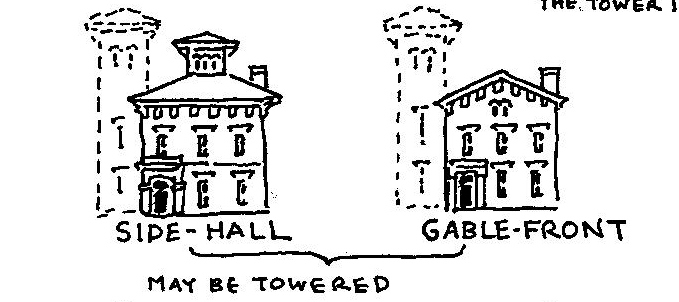
The plan of an Italianate house is one of the central features of the style and one of its greatest contributions to the architecture of the 19th century. Many of these (indicated by roman numerals that correspond to their numbers in Downing and Davis) were published and designed by Davis. Davis was usually the architect and planner behind the scheme of these two designers; Downing tended to focus on color and landscaping. The drawing above was done by me with the intention of pinpointing all the varieties of plan that exist in Downing and Davis and establishing a clear terminology for my entries. Of course, this is not an exhaustive schematic; Italianate plans can take literally any shape. In describing the Italianate style, Davis talks about two types of clients, those who appreciate regularity and those who admire picturesque but balanced irregularity. The symmetrical plan is the height of regularity since it is symmetrical. The irregular and side-tower plans are the height of balanced irregularity. Both remained popular throughout the life of Italianate architecture and were adapted for other styles, particularly Second Empire. You may notice that towers are optional additions for many plans. Italianate designers loved their campaniles, and they employed them when the client's taste and funds allowed. Any of these forms may potentially have a tower. A house with a tower, however, almost never includes a central cupola. Some of the plans, the five-bay and the gable front did not originate with Davis but hearken back to colonial and Greek Revival precedents. Nonetheless, they remain a part of the Italianate vocabulary despite their inherited nature. I will go through each plan to clarify how they function:

Irregular
The irregular plan is one of the most common, and expresses Davis' love of irregularly balanced forms. It hearkens back to the irregular, pragmatic clusters of wings and additions found in Italian monasteries and farm houses. The plan consists of a projecting pavilion that features often a bay or box window, at the left in this image (plans can always be reversed), a central tower that is slightly recessed from the projecting pavilion where the main entrance is commonly located, and a recessed section at right that tends to be longer than the projecting pavilion with a porch running across it. Thus the plan starting from the left gradually recedes. Sometimes it is called the L-shape plan or the Tuscan villa plan, but Davis used 'irregular' in his own description so I have adopted it as its name.

Symmetrical
The symmetrical plan is, as it is called, symmetrical, and is perhaps the most common form of Italianate you will see. It features a central entrance flanked on both sides by one bay, making it a three bay composition. The center very often features a gable or pediment in the cornice and the central second story window is usually differentiated from the others. The center bay in many examples projects from the façade. The house is almost always hip roofed and may have a cupola in the center of the roof.

Side-Tower

This towered plan is less common than the irregular plan. It features a projecting pavilion on the left and a projecting tower on the right. The central section is recessed and usually has a porch and is the location of the main entrance. The central recessed section is usually longer than the projecting pavilion and is often two or three bays wide. The base of the tower has commonly a window. As with the irregular plan, the projecting pavilion often features box or bay windows. Like the irregular plan, its inspiration is the farm houses and monasteries of Italy.

Pavilioned
Davis says that the pavilioned plan was designed and sent to him by the Philadelphia architect John Notman, It is symmetrical, featuring two projecting pavilions with a recessed central section. The central section features a porch and the main entrance. The published plan shows a large central tower topping the central section, but it is an extremely uncommon feature. The plan itself is not particularly common, but can occasionally be found or discerned under later changes.

Five-Bay
Having finished with Davis' plans, the five-bay is an inherited form from colonial architecture, where the symmetrical five-bay house with central entrance was dominant. This type may feature roof with end gables or a hip roof that may include a cupola. Sometimes the center of the house will have a gable over the door facing the front and even dormer windows. This house may include a tower to one side.

Central Tower
This plan, an adaptation of the symmetrical or five-bay plan features, as I call it, a central tower where the main entrance is located. The tower projects from the side wings, which may be one or two bays long. Thus the house could be a three or five-bay composition. There are often porches running along the sides from the tower.

Side-Hall and Gable-Front
These two plans, which I group together, are inheritances from Greek Revival. They differ primarily in their roof shapes. Each is a three-bay composition with a door placed to one side rather than in the center of the façade. These may include towers to the sides, and when they do I call them towered side-halls or towered gable-fronts. The side hall plan features a hip roof that may include a central cupola. The gable front has the gable end facing the front of the house. In the gable-front, there are often tombstone windows in the third story. These plans are both very common and represent the majority of middle-class Italianate designs. It is also a plan suited to urban construction.

Row-House
The row-house plan is probably one of the most commonly encountered types for those living in Northeastern urban centers. It is also an inheritance from Greek Revival row-homes developed in England. Though designed to be part of a long row of attached houses, a house can use this plan without being attached. The typical row-house is three stories, although two stories also occurs. It is three-bays wide with an off center entrance. Sometimes they may stand on a high basement with a long staircase leading to the entrance called a stoop. This elongated basement is known as an English basement. The roof is usually not hip, but sloped in some way or even flat. This type can but rarely includes a cupola or tower.
 
These then are the Italianate plans. Remember that Italianate can come in all shapes and sizes and a plan's social connotations, frequency, and ornamentation depend on varying vernacular and architectural criteria.

Classifying Albany's Cornices

This article might seem pedantic to some of you. Classifying cornices? Really? Albany has a wide variety of cornice types, but they tend to fall into categories of patterns. These patterns aren't just useful for looking at Albany's architecture; they are applicable to a wide variety of cornices in upstate New York and other areas like Cincinnati, the Midwest. I said that one aspect of this blog was to examine regional vernaculars, and Albany's cornices definitely fall into a vernacular style. These decorative and elaborate cornices are a product of the 1860s and 70s, when the sobriety of earlier Italianate design was embellished according to changing tastes. A look at furniture styles that were popular during this period, Renaissance revival and Eastlake, provide a good parallel for this type of elaboration in exterior architecture. The accretion of panels, projecting pieces, elaborate fringed borders, and heavy plaques reflect Renaissance revival furniture, while the incised decoration, made possible by the invention of new saws that saved time, and changes in principles of decoration from complex carved design to simpler outlines of symmetrically arranged vegetation reflect the influence of Eastlake. These elaborate cornices are less commonly seen on detached houses or houses outside of an urban setting in which the cornice runs around the entire building. They are extremely common on domestic architecture in a city and can be particularly found on commercial buildings. Elaboration such as this can sometimes be expressed in wood, but it is also a feature of cast iron cornices.

I use the term cornice loosely in this post. The cornice is properly on the top molding of an entablature, that consists of a top molding, cornice, bottom molding, architrave, and center section, the frieze. Properly I am classifying entablatures, but because cornice is so commonly used to denote the entire thing, I've decided to go with 'cornice', as a generalizing term.  The nomenclature I come up with and my division of these into types is my own. In doing so I hope to add a new level of classification to the vagaries that comprise Italianate architecture.

The Horizontal Cornice
The horizontal cornice is the most traditional type. The heavy top molding, the cornice, is supported by brackets, while the base molding, the architrave, is straight. The frieze, or the space between the cornice and architrave is only made up of horizontal bands of molding, often in various patterns like cable, dentil, or egg and dart.
 
The Paneled Cornice
 
The paneled cornice is one in which the frieze includes horizontal moldings as well as panels. The panels can be squares, rectangles, or even triangles. In general most other cornice types I will be discussing are paneled cornices that follow specific patterns.

The Arched Cornice

The arched cornice has a horizontal architrave and moldings, but its central feature is a strip of molding laid in a semicircle in the center. Often the spandrels, the triangular shapes to the upper right and left of the arch's curve, have shaped panels. The part within the arch may also have a panel. A keystone can also sometimes be found at the arch's center.

This third example, showing a normal arched cornice to the left also shows a variant to the right, where an arched third story window intersects the architrave.

The Bull's Eye Cornice

The bull's eye cornice is similar to the arched cornice. This cornice features a circular window or panel, a bull's eye window, that breaks the horizontal architrave and drops below it. The window is usually placed so that the center of the circle would be bisected by the architrave. To the right and the left, there are commonly panels that have curved edges that follow the circle's curve.

The Fillet Cornice

The fillet cornice is like the bull's eye in that it features a central window or panel in the shape of a rectangle filleted (with curved corners) in the upper two corners. The straight run of the architrave, however, is not broken. Panels to the right and left of the rectangle mirror the filleted corners of the central feature.

The Undulating Cornice

The undulating cornice is one in which the architrave itself forms an arch between longer brackets, creating a rippling effect when looking at the whole. Often the frieze moldings in this type of cornice will follow the curve of the architrave. There may be some type of fringe (lower picture) or drop (upper picture) descending from the arched architrave.

The Fringed Cornice

The fringed cornice is one in which the architrave is broken up or replaced entirely by a descending series of frieze sections that form a fringe, akin to the elaborate tassels attached to drapes. This fringed finish can take a variety of patterns. The upper image shows a geometrical diamond based fringe, while the lower shows a curved fringe.

In looking at these types, we can see that the last two, the fringe and undulating cornices, deal with the shape of the architrave, while the others deal with the frieze. The arched, bull's eye, and fillet cornices all feature a central section, an arch, circle, or rectangle, that panels are placed around. These three might be called 'medallion cornices' since they feature a central medallion. The treatment of these cornices has almost endless variation, although they tend to fall into these types. There is always an outstanding cornice here or there; how a cornice is treated can be as diverse as builder's minds. These cornices, however, are often the most elaborate and distinctive pieces of these otherwise uniform row houses. It is in the trimming of this traditional form that the builder or owner could express themselves and make an impression. Thus, what we are looking at in these varieties of decoration is a vernacular method of social presentation and individuality that today makes strolling down Albany's streets a delight.