Showing posts with label Andrew Jackson Downing. Show all posts

Thursday, March 24, 2016

The Edward King House, Newport, RI-the Double Tower Plan

The Edward King House, Newport, RI. 1845 Photo: Wikimedia
I'm introducing a new plan today; it's one of the rarest Italianate plans, hence it's lack of inclusion in the initial plan post. The first example of this plan, which was developed by the famous architect Richard Upjohn, is the Edward King house in Newport, RI (1845). The earliest phase of Italianate design was a period of experimentation with the Italianate form and a constant search for the combination of towers and volumes that would create the most "picturesque" and romantic design. The King house is of the same early period as Blandwood (1844), the earliest Italianate, in Greensboro. Basically, the plan is almost a square, but the volumes are dramatically broken up by the front facade which has two projecting towers around a central recessed bay. Hence, I call it the "double tower plan". This closely resembles the plans which I call the "pavilion plan" and the "side tower plan" in that the emphasis is placed on the corners on the house rather than a central feature, and the double tower plan belongs in this family of designs.


The primary difference is that in the double tower plan, the corners of the house have emphatic masses that counteract the horizontality of these other plans. The two towers are usually romantically varied by being different heights. Additionally, the central mass is de-emphasized by having both its decoration and volume compacted and simplified. The double tower plan was widely praised in its day. Andrew Downing published the King house and its plan in his Architecture of Country Houses:


Downing offered the above illustrations of the plan and design of the house, and added of the form: "The sky outline of this villa has the characteristic irregularity of the Italian school of design, and the grouping of the whole is a good study for the young architect who is embarrassed at how to treat a large square mass of a building-for the ground plan is nearly square". Downing continues gushing about the design, citing its harmony despite the many window forms, and calling it "one of the most successful specimens of Italian design in the United States".

In looking at the King house, built in brick and brownstone for a wealthy Newport landowner and merchant, one can see what Downing is talking about. The corner towers are thick, much thicker than a typical Italianate tower, and they vary in both height, projection, and design. The left hand tower is less emphatic, with rectangular windows with open pediments on the first floor, tombstone windows with a wooden awning, and three arched windows on the top stage. The right hand tower projects much further and is far wider than the left. The first floor here has a large round arched window with Venetian tracery, a triple rectangular window with both a balcony and fringed wooden awning, and triple arched windows on the top stage; this same window variation can be found on the tower's side. The central bay of the facade is recessed with triple arched palladian shapes on each level. This is repeated on the pavilion on the right hand facade, with a triple arched palladian on the first floor and a round headed window with a balcony on the second. The several Juliette balconies particularly seem to create a sense of fantasy. The whole is topped with closely spaced s curve brackets in the Anglo-Italianate tradition, an early feature.

The King house, after spending most of the 20th century as a public library, is currently a very fancy senior facility on whose website you can see some interior pictures.

Saturday, June 22, 2013

Painting the Italianate House

The subject of painting an Italianate house is one that is still of concern today. Often, owners who buy an old house are confronted with a horrendous, bizarre, historically inaccurate, or just plain ugly paint scheme that destroys the house's effect. Paint is as important a part of architectural design as anything else, and the creators of Italianate homes put as much thought into their paint schemes as the design. For advice on painting a 19th century home, I recommend wholeheartedly Victorian Exterior Decoration: How to Paint your Nineteenth-Century American House Historically by Roger W. Moss and Gail Caskey Winkler, an invaluable source of information for painting all types of Victorian homes. It is to their work I owe most of this discussion.

Before the 1840s, most American homes were painted white with accompanying green shutters. Despite the various wild colors found on Colonial houses such as black, red, bright yellow, dark blue (an electric blue house in historic Deerfield comes to mind), Federal architecture and especially Greek Revival favored a stark white, no doubt to simulate the classical white stone of ancient Greece (of course Greek architecture historically was painted a variety of zany colors, but they didn't know that very well at the time!). In Cottage Residences, Downing railed at this prevailing custom, saying "the glaring nature of this color when seen in contrast with the soft green of foliage, renders it extremely unpleasant to an eye attuned to the harmony of coloring, but its very great prevalence in the United States could render even some men of taste heedless of its bad effect. No painter of landscapes that has possessed a name, was ever guilty of displaying in his pictures a glaring white house...on the contrary...the buildings have a mellow softened shade of color in exquisite keeping with the surrounding objects." (14-15)

For Downing because houses were set in a natural landscape and white is not a 'natural' color, its presence was incongruous with its surroundings. The pleasing effect of sunset and the variation between shades due to shifting light inspired Downing's disapproval of white, a color that was "always lighted up" and never mellowed by changing light. He advises that houses should be painted the color of "soil, rocks, wood, and bark" to harmonize with objects in the landscape rather than contrasting with them. He also maintained a larger house should be painted a darker color while a smaller house should be painted lighter because of its exposure. Trim should be painted several shades darker than the main body of the house. To illustrate his ideas, Downing in Cottage Residences produced a hand painted example of appropriate house colors, pictured below. A, B, and C, he remarks, are shades of grey while E, F, and G are "drab or fawn color"; Downing preferred the fawn shades especially because they simulated Portland Stone.


Although Downing's color palette was not completely followed (green for the main body was advocated by some of his followers and lighter trim was often allowed), the main colors for a home were overall grey or brown. Sometimes light blue, light purple, and pinks were used as well and represent more flamboyant but historical colors. In 1861, John Riddell's book, Architectural Designs for Modern Country Residences (which can be viewed here) included the first color plates showing appropriate colors for houses. I have posted a few below, but the book includes several more. This book is essential to knowing about how houses were painted in the early 1860s. Downing's palette is evidenced here, although there are variations.

We can see the variations of fawn and grey along with yellow. Trim in these houses is often a lighter shade, and certain details, especially the stripes on the cupola trim are picked out. One aspect to note is the painting of the tent roofs with stripes; this was a particularly common custom on Italianates that is rarely in evidence today. Although it might seem ridiculous or garish, that's how they did it. Notice as well how the architect takes drape color into consideration. I believe the varying drapes represent alternatives for a house. In the first example below, the drapes could be red or blue. Sometimes in the plates they even fill the cupola with cloth. For Riddell, the drapes seen from the street were an important part of the effect and should have a uniformity. Finally note the main roofs. Unlike the typical grey roof we expect, many of these houses have tin, copper, or tile roofs. Although of course grey slate was often used, there was always a preference for more colorful roof effects especially tile which simulated Italian architectural practice.


Ultimately, this color scheme may strike us a dull. Come on, it only includes grey, yellow, and brown! What about the colorful "painted ladies"? The painted lady style, which originated in San Francisco in the 1890s was California specific and much criticized at the time. Although it may be appealing to make your house in New York or Ohio stand out with bright colors, that doesn't reflect historical practice at all. Another thing to consider is that the Victorians loved to simulate more expensive materials; it was a world of artifice. Doors of pine were painted to look like more expensive wood (faux graining), for example. Often a house may have some stone elements such as window surrounds or lintels, and when these are of stone, the wooden trim and architectural elements should be painted to resemble the color of the stone parts. Also keep in mind that the usual finish for an Italianate was either stucco or brick. Both were often painted and the chimney as well was painted to match the house's color.

As the 1870s arrived, darker colors began to be applied to houses, especially olive, green, and orange. This period loved 'tertiary colors' or colors made from mixing two secondary colors like russet (violet and orange), citrine (green and violet) and olive (green and orange). These tertiary colors were destined in the 1880s to mostly replace Downing's scheme as the current fashion although the Downing palette remained throughout the century. Italianate was waning by the 1880s, though, so these colors apply to late Italianates of the 1870s, when the Downing palette was still popular, and Queen Ann houses, where they dominated. The white trim was more an influence of colonial revival design in the 1880s and 1890s. Previous to the interest in colorfully painted Victorian homes in the later 20th century, the fashion was to paint the houses completely white to lessen the drama of the very out of fashion architectural complexity. I agree with Downing that this is the worst way to paint a Victorian. Not only is it inaccurate, but it makes a house filled with architectural interest boring and flat when it should be fun!

The Victorian house, and the Italianate in particular, should be colorful but not overly so. If you want to achieve the original effect that the architect or designer had in mind with your house, work within the right palette to keep a level of design integrity.

Wednesday, May 8, 2013

The Italianate Plan

The plan of an Italianate house is one of the central features of the style and one of its greatest contributions to the architecture of the 19th century. Many of these (indicated by roman numerals that correspond to their numbers in Downing and Davis) were published and designed by Davis. Davis was usually the architect and planner behind the scheme of these two designers; Downing tended to focus on color and landscaping. The drawing above was done by me with the intention of pinpointing all the varieties of plan that exist in Downing and Davis and establishing a clear terminology for my entries. Of course, this is not an exhaustive schematic; Italianate plans can take literally any shape. In describing the Italianate style, Davis talks about two types of clients, those who appreciate regularity and those who admire picturesque but balanced irregularity. The symmetrical plan is the height of regularity since it is symmetrical. The irregular and side-tower plans are the height of balanced irregularity. Both remained popular throughout the life of Italianate architecture and were adapted for other styles, particularly Second Empire. You may notice that towers are optional additions for many plans. Italianate designers loved their campaniles, and they employed them when the client's taste and funds allowed. Any of these forms may potentially have a tower. A house with a tower, however, almost never includes a central cupola. Some of the plans, the five-bay and the gable front did not originate with Davis but hearken back to colonial and Greek Revival precedents. Nonetheless, they remain a part of the Italianate vocabulary despite their inherited nature. I will go through each plan to clarify how they function:

Irregular
The irregular plan is one of the most common, and expresses Davis' love of irregularly balanced forms. It hearkens back to the irregular, pragmatic clusters of wings and additions found in Italian monasteries and farm houses. The plan consists of a projecting pavilion that features often a bay or box window, at the left in this image (plans can always be reversed), a central tower that is slightly recessed from the projecting pavilion where the main entrance is commonly located, and a recessed section at right that tends to be longer than the projecting pavilion with a porch running across it. Thus the plan starting from the left gradually recedes. Sometimes it is called the L-shape plan or the Tuscan villa plan, but Davis used 'irregular' in his own description so I have adopted it as its name.

Symmetrical
The symmetrical plan is, as it is called, symmetrical, and is perhaps the most common form of Italianate you will see. It features a central entrance flanked on both sides by one bay, making it a three bay composition. The center very often features a gable or pediment in the cornice and the central second story window is usually differentiated from the others. The center bay in many examples projects from the façade. The house is almost always hip roofed and may have a cupola in the center of the roof.

Side-Tower

This towered plan is less common than the irregular plan. It features a projecting pavilion on the left and a projecting tower on the right. The central section is recessed and usually has a porch and is the location of the main entrance. The central recessed section is usually longer than the projecting pavilion and is often two or three bays wide. The base of the tower has commonly a window. As with the irregular plan, the projecting pavilion often features box or bay windows. Like the irregular plan, its inspiration is the farm houses and monasteries of Italy.

Pavilioned
Davis says that the pavilioned plan was designed and sent to him by the Philadelphia architect John Notman, It is symmetrical, featuring two projecting pavilions with a recessed central section. The central section features a porch and the main entrance. The published plan shows a large central tower topping the central section, but it is an extremely uncommon feature. The plan itself is not particularly common, but can occasionally be found or discerned under later changes.

Five-Bay
Having finished with Davis' plans, the five-bay is an inherited form from colonial architecture, where the symmetrical five-bay house with central entrance was dominant. This type may feature roof with end gables or a hip roof that may include a cupola. Sometimes the center of the house will have a gable over the door facing the front and even dormer windows. This house may include a tower to one side.

Central Tower
This plan, an adaptation of the symmetrical or five-bay plan features, as I call it, a central tower where the main entrance is located. The tower projects from the side wings, which may be one or two bays long. Thus the house could be a three or five-bay composition. There are often porches running along the sides from the tower.

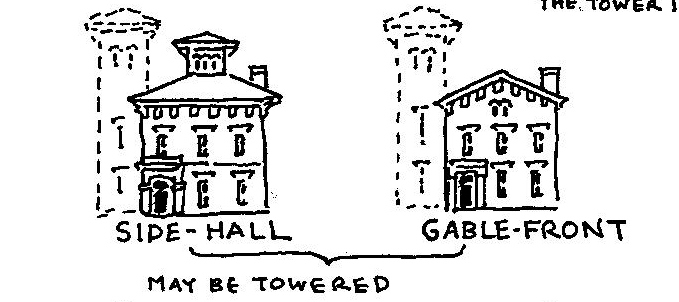
Side-Hall and Gable-Front
These two plans, which I group together, are inheritances from Greek Revival. They differ primarily in their roof shapes. Each is a three-bay composition with a door placed to one side rather than in the center of the façade. These may include towers to the sides, and when they do I call them towered side-halls or towered gable-fronts. The side hall plan features a hip roof that may include a central cupola. The gable front has the gable end facing the front of the house. In the gable-front, there are often tombstone windows in the third story. These plans are both very common and represent the majority of middle-class Italianate designs. It is also a plan suited to urban construction.

Row-House
The row-house plan is probably one of the most commonly encountered types for those living in Northeastern urban centers. It is also an inheritance from Greek Revival row-homes developed in England. Though designed to be part of a long row of attached houses, a house can use this plan without being attached. The typical row-house is three stories, although two stories also occurs. It is three-bays wide with an off center entrance. Sometimes they may stand on a high basement with a long staircase leading to the entrance called a stoop. This elongated basement is known as an English basement. The roof is usually not hip, but sloped in some way or even flat. This type can but rarely includes a cupola or tower.
 
These then are the Italianate plans. Remember that Italianate can come in all shapes and sizes and a plan's social connotations, frequency, and ornamentation depend on varying vernacular and architectural criteria.

Tuesday, April 23, 2013

What do I mean by Italianate?

"Victoria Mansion" in Portland, ME. The house is more suitably known as the Morse-Libby House and was built in 1860. It is a 'textbook example of Italianate architecture and was designed by Henry Austin. Image from Wikipedia.


In answer to the question I posed in my title, one could say a lot. Italianate is a 19th century architectural style, a system of ornamentation, a mode of designing house plans, a romantic or downright silly interpretation of Northern Italian building, a Victorian horror... The Italianate style can be viewed as all of these things. It was perhaps the most popular and most long-lived architectural style of the 19th century, yet there exists no comprehensive monograph or study of it on its own. Without the grandiosity of Second Empire, the restlessness of Queen Anne, the ponderousness of Gothic Revival, or the reasoned calmness of Greek Revival, Italianate architecture seems to fall by the wayside in discussions of 19th century style. Often when I've talked to my friends about it, their answer is that this or that Italianate building just looks like "a regular old building" to them. Some of us live our lives around Italianate architecture without even noticing it. This blog attempts to address this lack of interest by looking at American Italianate architecture, primarily domestic, and hopefully showing that indeed Italianate can express restlessness, grandness, calm, and weightiness. Because of its long life and its adaptation in nearly every geography of the US, Italianate architecture developed a versatility; it became a simple canvas on which many concepts could be grafted, whether those visions suggested Florence, London, Athens, or even Delhi. Living in New Haven, Connecticut, a city and state which both have a rich relationship with Italianate architecture, I have come to appreciate just how complex and malleable this style is, and so I decided to write this blog.

 
I'd like to start off with a little discussion about what Italianate architecture is. It is a style of building that was popular throughout the 19th century which took its inspiration from the monasteries and villas of Medieval and Renaissance Northern Italy. It did not aim to be a replication of its prototypes, but rather a representation in a concentrated form of the monasteries it emulated. The first Italianate building is generally considered Cronkhill House in the UK, designed by John Nash in 1802, pictured to the right (image from wikimedia commons.) In essence, Cronkhill is a Regency cube, stuccoed, with two asymmetrically placed towers. It has broad overhanging eaves with notable supporting brackets and low hipped roofs. All these features are the hallmarks of the Italianate Style, although Cronkhill does not express them to the degree that they would be in the US. Italianate began in England, but changes and reinterpretations of its precepts when it arrived in the US altered it so much that American Italianate is its own unique style with its own vocabulary and variations.

Italianate was introduced to the US by Alexander Jackson Davis (1803-1892) and Andrew Jackson Downing (1815-1852) in their book Cottage Residences (1842). In this hugely influential book, Davis and Downing provided plans for country houses in a variety of styles (Gothic, Swiss, Italian etc.), discussed the suitability of each style, provided exterior decorative and gardening ideas, and discussed proper color choices.  They characterized the 'Italian Style' as suitable for a warm climate because of its verandahs and balconies and said that the style recalls "to one familiar with Italy and art, by its bold roof lines, its campanile and its shady balconies, the classic beauty of that fair and smiling land, where pictures, sculpted figures, vases and urns...make part of the decorations". For Davis and Downing, the Italian style was a romantic form that suggested to its beholder (their man of artistic and picturesque appreciation) thoughts of Italy and its artistic associations and warm Mediterranean climate. In a world of the Grand Tour and an emphasis on Italian art and architecture, in which one's class was displayed through one's aesthetic refinement, the Italianate style could not have failed to prosper.

The essential hallmarks of Italianate architecture included for Davis and Downing:
  • Very broad eaves supported by strong, noticeable brackets. The notability of these brackets sometimes caused the style to be called "Bracketed". The brackets and eaves remain the most significant stylistic feature of Italianate architecture.
  • Low hipped roofs. These low roofs mimicked the roofs of Italian architecture, although occasionally on towers and cupolas different roofs could be employed. As the style evolved in the 1870s a higher pitched hip roof was developed.
  • A tower or cupola. Irregularly planned houses usually feature a tall tower or campanile. Symmetrical villas often have a cupola or belvedere in the center of the hip roof.
  • Verandahs. Often the verandah runs the length or part of the length of an Italianate house. Sometimes verandahs are included on the sides between projecting sections.
  • Irregular or Regular Plans. These two types of plans form the basis of most Italianate houses, although the style was adapted for use with a variety of plans and shapes.
  • Other features include 'Juliette' balconies, exterior wooden awnings (projecting eaves over windows), tent roofs, two story porches, bay windows, and elaborate hood moldings around windows. The various features of Italianate can vary from builder to builder and region to region.
Two of Davis' plans particularly characterize Italianate architecture, the symmetrical and the irregular. The symmetrical plan of an Italianate house involves the door centered on the façade with two bays flanking it. The irregular plan, or as Davis says, the embodiment of "artistical irregularity" is more complicated. It involves in order from one side of the front façade to the other a projecting pavilion, usually with one central window, a tower which is recessed from the projecting pavilion, which is where the door is often located, and a set-back pavilion which may have a lower roofline than the projecting pavilion and is often fronted by a porch. This set-back pavilion is usually longer than the projecting pavilion. The Morse Libby House in Portland pictured above is a classic example of the irregular plan. The picture at the left shows Downing and Davis' plan for an irregular Italian villa (from Wikimedia). The picture below shows a symmetrical Italianate villa on Orange Street in New Haven. Although the two story porch is uncommon, nonetheless it reflects the symmetrical plan.

A symmetrical Italianate plan on Orange Street in New Haven. The Watson-Coe House 1867-1868.

Of course, Italianate architecture uses a variety of plans. The gable-front Greek revival plan as well as the five bay Georgian plan (whether with a hip roof or gable ends) persisted through the 19th century and many Italianate houses follow these plans. A great many Italianate homes follow the side-hall plan, in which the door is placed to one side of a three bay composition. There is also another type of towered plan in which the tower is placed to one side of the composition and the projecting pavilion is placed at another with a recessed section connecting them, which I call the "side-tower" plan. Although they may seem tedious, these plans are significant for the development of other styles as well. Second Empire architecture, for instance, often closely follows these plans, simply adding a mansard roof into the composition. I have drawn a pretty basic chart of these various plans, of course variations will be dealt with as they come up.

 
So much for plans. I'd like to add a few more things before I conclude this post. First, Italianate, as I've said, is a flexible style. It was never dominated by one particular style of ornamentation and detail. Perhaps the most striking example of this is Henry Austin's application of Indian (or as he might have said 'Saracenic') ornament to the Italianate plan. These houses in essence retain the style and feel of Italianate even though there are elements of Indian architecture in the design. Another style which was often applied was the so-called "Steamboat Gothic", which consists of porches (usually) with elaborate and complex jigsaw work that doesn't particularly fall into any of the traditional stylistic categories. Italianates can be the best examples of regional and personal vernacular in the US. As time went on each new generation's concept of ornament was applied to the Italianate plan and thus we can see the whole range of styles and decades reflected in Italianate houses.

Italianate architecture was versatile in its use outside of domestic architecture. Although Davis and Downing envisioned it as a style suited to warmer climates and country or suburban villas, it was used in urban row-houses, churches, schools, public and commercial buildings, and even cemetery mausoleums. Although this blog focuses primarily on domestic design, I will sometimes include examples of other types of structures which have their own quirks. I would welcome photo submissions from people who would like to have an Italianate house or building in their area posted. I would ask that when doing so you try to include a general picture of the building, views from both sides and close-ups of unique details. It's been a long post, but introductions always have to be a bit long and complex. At any rate, I will post some interesting new buildings soon for your consideration.