Showing posts with label plantation. Show all posts

Thursday, December 7, 2017

'Longwood' the Haller Nutt House, Natchez, MS

'Longwood' the Haller Nutt House, Natchez, MS. 1859 Photo: Wikimedia
'Longwood' is perhaps Sloan's most famous commission, his most eccentric, and his greatest unrealized project. Dr. Haller Nutt, a wealthy planter and agricultural inventor, commissioned Sloan to design the house in 1859, and by 1861, the exterior was completed. The outbreak of the Civil War, however, caused the workmen from Philadelphia to abandon the project and return north. The house was left with a finished exterior, but an unfinished interior, with only the basement complete and the remainder framed. The house suffered neglect, as Nutt lost most of his wealth during the war, but has been restored as a tourist venue. As a unique survival, Longwood provides us with a wealth of information on the process of construction and framing in the 19th century, an ironic testament to the work of Sloan as a pioneer of balloon framing. Additionally, the house is one of the most important and well known monuments of Indian Italianate in the US.

Sloan's design for the house, an octagon, was based on the briefly popular octagon shape popularized by Orson Quire Fowler, a lifestyle theorist in the 19th century who theorized that the octagon shape was more healthful and economical, leading to a spate of houses based on Fowler's designs. The plan that Sloan selected as the basis of Longwood was published in the Model Architect v.2 in 1852 as an "Oriental Villa". It remains one of the most elaborate examples of the fanciful strain of Indian Italianate design in the US, but, like the style in general, it remains Italianate to the core with a spattering of oriental details and design elements.
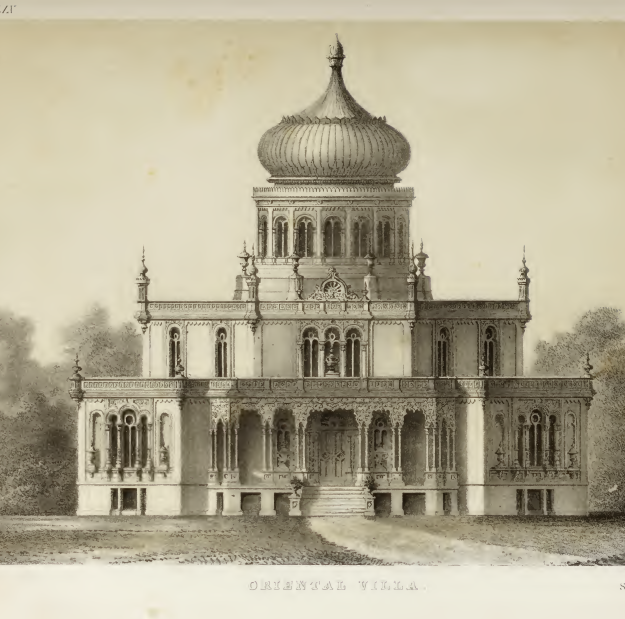
The original design:


The plan is octagonal, but Sloan has complicated the design. Four of the facades on the first two stories project by several bays, forming a Greek cross shape; these bays alternate with double storied porches, filling out the octagon shape. Each façade on these first two stories has three arched windows; on the projecting facades, these are closely spaced with a hanging porch on the first floor with three arches answering the windows. One the recessed facades, there are two windows flanking a door on each story, forming three arched openings. The third floor reverses the rhythm of projections and recesses on the first two; where the façade projects on the first two stories, it recedes on the third and vice versa. The fourth floor abandons the triple arched motif in favor of paired tombstone windows, a typical Sloan maneuver to differentiate the third floor. The whole is topped by a tall polygonal drum with arched windows and an onion dome, the consummate Indian/Mughal design element.

As much as the house makes a pretense of Indian design features, it doesn't nearly capture the authenticity of Henry Austin's Indian houses in New Haven, such as the employment of candelabra columns. Rather, it uses primarily vernacular Italianate motifs, but arranges them in such a way as to suggest the oriental world. For instance, a look at the double story porches shows Corinthian columns (of a slightly lusher variety than a strictly classical design), but the scrollwork on the porch is designed to mimic the horseshoe arches and ogee shapes in Islamic architecture. Horseshoe arches can also be found on the balustrades. On the side balconies, we see horse shoe arches again with interesting moldings above the columns, a further feature that recalls the Alhambra. Finally, the fringes on every cornice line and the dome itself, which has an onion shape, pull the entire composition into the Indian mode. One bizarre feature that I am at a loss to explain is the strange tracery in the windows, which looks more Chippendale gothic than Moorish.

All following photos from Wikimedia.


Unfortunately, the interiors were never finished, but this allows us a good glimpse of the construction methods of the house:


Tuesday, February 9, 2016

'Two Rivers' the David McGavock House, Nashville, TN

'Two Rivers', Nashville, TN. 1859 Photo: Brent Moore
Photo: Wikimedia
If this plantation, built in 1859 for the very wealthy McGavock family could have something elaborate, it does. In fact, it's a surprisingly urban design one might see in a wealthy city rather than in the countryside, which testifies to the taste and wealth of the family. It was eventually sold to the city which built a golf course around it. The house has a symmetrical plan, but the facade is far more elongated than the typical symmetrical box, somewhat dwarfing the windows in a sea of brick. The house creates rhythm and emphasis by defining the side bays with paneled brick pilasters and causing the central bay to project through its heavy, elaborate porches. As usual, the central bay differs from the side bays. The sides have rectangular windows topped by flat hood moldings with swirling rococo foliage. The central window is a segmentally arched with Venetian tracery that has not two but three windows contained within it, an uncommon design. This is topped by a drip molding. The central door is recessed and flanked by arched windows.

The porches run across the facade on the first floor and the central bay on the second, creating that all important central emphasis on a symmetrical house. In that, this house has some affinity with the New Orleans Porch Facade type. The thick paneled pilasters create filleted rectangular openings which feature brackets with carved acanthus leaves, raised diamond panels, and rosettes, no doubt reproduced carefully from a Greek Revival pattern book. The balusters are a Renaissance type, another indication of wealth (turned balusters cost money, especially that many). The cornice is paneled, with variations of s scroll acanthus leaf brackets and simple s scroll designs that are paired on the main facade. The central section is topped by a boxy paneled attic with a few carved moldings and vegetable accents. The cornice wraps around the entire house, but the facade treatment is not repeated on the sides which have a simpler design. HABS documented the house and provided the interior views and plans seen below.


Sunday, February 7, 2016

'Oaklands' the Lewis Maney House, Murfreesboro, TN

'Oaklands' Murfreesboro, TN. 1860 Photos: Brent Moore

Although I put a date on this house of 1860, I might have equally put 1820 or 1830. Like many plantation houses, Oaklands started life as a small two room house that accrued additions, ells, and wings. When Dr. Maney built his original home, he was in effect a settler, but after his wife died and he retired, his son Lewis took control of the home. Lewis added the Italianate facade in 1860, designed by local architect Richard Sanders, turning the old settler's home into a fashionable mansion, even if the Italianate design was more of a false front hiding a complex past. After the Civil War, the Maneys struggled to hold on with dwindling finances and eventually sold Oaklands to a string of owners. It was abandoned, vandalized, and threatened in the 1950s, but was bought and restored; it is now a house museum.

The house is a five bay plan with a strongly projecting central pavilion, The windows are rectangular with simple flat hood moldings crowned with elaborate rococo flowers and vines. The central window is arched with thick Venetian tracery, so common in other Italianates in Tennessee. The simple cornice has s scroll brackets. What really distinguishes this house is its impressive porch which spans beyond the entire front of the facade. It's a simple Italianate porch with an interesting rhythm of square pillars and arched sections with brackets. As part of the illusory nature of the redesign, from a purely frontal view it looks like it wraps around the entire house, but when one looks from a side view, the porch's dimensions seem rather ridiculous and the design's illusion becomes clear, especially against the earlier 19th century side facades. HABS documented the building in the 1930s before it was vandalized, including several interior views, below.


Thursday, February 5, 2015

'Mount Holly', the Charles Dudley House, Foote, MS

'Mount Holly', Foote, MS. 1856 Photos: Joseph


'Mount Holly' is a plantation house is central Mississippi built in 1856 for Charles Dudley. It was designed by either Samuel Sloan or Calvert Vaux, two of the most important Italianate architects practicing in the mid 19th century. Calvert Vaux is a strong contender, since the house closely resembles one of his published plans. Only an architect's intervention could explain the defining odd feature of the house, the fact that it conforms roughly to the irregular plan, but it lacks two of the most important features found on this style. First and most obvious, there is no tower. Rather the place where the tower should rise is a strongly projecting, gabled bay. Second, is the fact that the 'tower' element projects further than the left hand section that should extend the furthest. The emphasis has been entirely shifted to the center of the house, even though it is clearly irregular because of the strong recess on the right wing and the projection of the left wing.

Ornamentally, the house is as spare as they come. There are no window moldings, just paired tombstone windows. The brackets are paired as well, simple, and united by a architrave molding. Even the porches are simple, consisting of plain arches and square columns. The house was almost certainly stuccoed in some pastel beige. However, playfulness appears in the central door. It is recessed in a portico that is triple arched Palladian in form with an elaborate cornice, large, acanthus leaf brackets, and small brackets. This is a surprisingly high-style porch on a house that doesn't have a lot of ornament, and it relieves the simplicity of the facade. The chimneys as well have toothed and paneled brickwork. The house is currently abandoned by its owner and was listed in 2011 as one of Mississippi's most endangered places. The plan below is taken from one of Clavert Vaux' drawings on which the house seems to have been based and perhaps shows how the interior is arranged.

NOTE: This house burned down June 17, 2015


Photo: HABS

Tuesday, June 25, 2013

Mayhurst: the John Willis House, Orange, VA

Photo: Wikimedia

Drawings from HABS
This plantation house, one of the most exuberant I have seen, is in Orange, Virginia. It was built in 1859-1860 for John Willis, a relative of President James Madison who named the house "Howard Place". It passed through various owners before it was renamed "Mayhurst" in 1902. The house follows the symmetrical plan with a hip roof and cupola and is faced with wood that has been cut to simulate stone, an elegant and costly effect. The house may have been designed by Norris G. Starkweather, who designed a similar house that I have featured, Camden, nearby. The embellishments to the design and the inventiveness and variety are characteristic of his style. Another candidate is Charles Haskins, another architect in the area. Regardless of who designed it, it is definitely the product of the architect rather than the carpenter/builder. 

The symmetrical house features central gables on each side. The basement is brick with paired windows. The first floor features paired, shallowly arched windows with balconies and simple hood moldings. The front door is arched with a glass surround and is fronted by an unusually simple three bay porch that could be a later replacement for another porch. The second floor is where the eccentricities arise. The flanking windows are Palladian, an unexpected choice. They have a bracketed hood molding, and the center panel features Venetian tracery. The second floor side windows mirror the central panel's tracery and shape. The central window on the front has two arched windows supporting a large 'rose window' with spoke tracery. In essence this is a sort of exaggerated Venetian tracery, and is a very uncommon shape especially for a private home. I have only seen examples of this type of window on churches and public buildings, so its presence in a private home is noteworthy. On the sides, the rose window is repeated under the gable with a drippy hood molding. 

Approaching the third floor, the cornice is undulating and is pierced by small windows. The brackets are of the c and s scroll type and are placed in a somewhat odd pattern with one at each corner, then pairs, then two small brackets framing each window. Each gable is topped by an anthemion, a stylized palmette. These cut out appliques are also found on the impressive cupola. The cupola has an odd manifestation of Palladian windows with a pointed central window and flat flanking ones. The cornice follows the window line and is gabled, reflecting the general form of the house. The cupola roof is fantastic; it is bulbous and forms one giant spire that has cut out decorations ascending to it. The color choice for the house, all white, is unfortunate because it flattens out the details in a way that makes the house look more dull than it is. In the early 20th century, the way people handled Victorian exuberance was to tone it down with monochromatic paint schemes, which are not at all period appropriate and reflects a disdain for Victorian ornament and design. The house is currently a bed and breakfast; a look on their website will show you some interiors.

HABS has a plan on record for the house:


Monday, June 24, 2013

Camden: the William Pratt House, Port Royal, VA

Camden, Port Royal, VA. 1857-59 Photos: HABS


When we think of plantation houses, our minds usually conjure up Greek Revival mansions surrounded with white columns. The truth is, however, that though they are not as common southern plantations can be Gothic or even Italianate. They run the gamut of styles. Camden is a particularly well documented example of an Italianate plantation house. Constructed by William Pratt between 1857 and 1859 after he demolished his family's Colonial house, Camden is a star example of southern Italianate plantation architecture. The architect was Norris G. Starkweather, an important architect in Philadelphia and Baltimore who was responsible for the design of the Backus house in Baltimore. There is a certain similarity to these houses. The house is a symmetrical plan mansion, which originally included a tower which was destroyed during the Civil War. The plans show how the tower was integrated into the design at the back of the house, appearing as a large cupola from the front. After the war, the tower was not reconstructed, but Starkweather's elevations for this house survive. The siding is flush board, giving a smooth surface appearance.


The house is beautifully composed and detailed. The front facade is three bays with a central gable; all the gables in this house have semi-circular windows in them, a throwback to Federal design. The first floor windows are tripartite Greek Revival windows. Above them on the second floor, pairs of segmental arched windows flank a tripartite round headed window with a taller central panel, just like we saw in the Backus house. The right facade continues the segmental arched windows and is three bays, but the center features a tombstone window united under an arch, making it appear like Venetian tracery. While the hood moldings are very simple, they resemble the Backus house in the elaborate jigsawed rococo motifs over the windows. The right facade also has a unique feature, a massive bay window conservatory with Venetian tracery windows. The first floor is mostly surrounded by a large wraparound porch that is bracketed with trefoil flat topped arches and that features square posts elaborated with chamfered edges and inset panels. The cornice is also elaborate with paired double s-scroll brackets, finials at the bracket ends, drops at the base of each bracket, and long receding dentils. I particularly like how a bracket was cut carefully so that where the cornice breaks on the facade at the gable, there is a bracket in profile. From the plans it appears that balustrades and palmettes topped the porches and the bay window, but these must have been removed.

The tower was truly a lovely piece. The stump of it remains on the back of the house. From the designs, the base of the tower had an arched door like the front door that had a glass surround. The second stage copied the front as well with a triple arched window. The third stage was separated by a belt course and had semicircular windows that had jigsawed scroll work above them. The top of the tower had highly elongated brackets that filled the entire upper story. In the center were Palladian windows with balconies. The cornice had an arch in the center of each side that had anthemia (vegetable decorations at the peak of a gable) and palmettes. The whole was covered with a hip roof and an impressively tall spire. The tower would have been beathtaking and was certainly envisioned as the pearl of the entire composition. If anyone's looking to blow some money on a historic restoration...

Another interesting feature is the left facade of the house that has the servants' wing. This is simpler in detailing but nonetheless grand. A porch faces the front of the house. But the side has a reversal of the house's formula, with segmental arched windows on the first floor and round headed ones on the second. A pedimented door with a bracket surround (an interesting feature we have noticed in this area) is in the center bay. Another quirky detail are the paired tombstone blind arches on the chimney. The house betrays the careful thought and design of a real architect from tower to chimneys. Along with the Backus house, they remain two interesting Italianate works for this architect and deserve to be considered alongside each other. The interior also remains intact and retains some of the family's original furniture. All the following pictures are from HABS, and it is worth a look at their 38 photographs online.


Note how the triple arched window on the front is repeated in the doors of the front hall. Also the glass surround for the door is a particularly impressive specimen.


The parlor still has its original furnishings. The oval mirror is impressive!


Even the gasolier light fixtures are in place. This shows also the finely crafted plaster ceiling medallions.

Sunday, May 12, 2013

The Pleasant M. Craigmiles House, Cleveland, TN

P. M. Craigmiles House, Cleveland, TN. 1866. Photo: Brent Moore.

Photo: Wikimedia.
The Craigmiles house was built in 1866 as an announcement to the community that it was time to reconstruct after the Civil War. The builder, Pleasant Craigmiles and his family seem to have been an important local family with business concerns and buildings all around Cleveland. In 1923, the house was donated with several thousand volumes to serve as the city's library, and today it remains the history and archives branch of the library. This irregular plan Italianate has a graceful simplicity and balance of forms. It seems to eschew the complexities seen in some other post-bellum designs. Like other houses we have seen, this house maintains its horizontality with the cornice (consisting of simple paired brackets and dentil moldings) extending across the tower. An interesting feature is the jutting courses of brick brackets extending under the tower's cornice. This lends the tower a greater thrust to its height and eave overhang, asserting its importance, as does the tall finial.

The house is a testament to arches. A simple arch in the tower base serves as the main entrance with an arched porch with pierced spandrels extending on the recessed section. The windows almost all consist of Venetian/Florentine tracery and are doubled. The arch is again repeated in the windows and hood moldings (which include pearl moldings, or moldings with hemispheres placed at regular intervals) of the first story bay window. The ghosting in the brick and old photographs tell us the bay window and the main porch once had a balustrade. They really should be restored! A particularly lovely feature is the unexpected right hand wing with its three bay porch. This wing is lower than the rest of the house, consisting of a story and a half. The same arch motif is repeated here in the cornice's round gable and window. Two circular windows flank the round central window, creating a pleasing variation. This wing visually balances the house without overpowering any part of it as a full two story wing might have done, making the house look too large. It might have been handled in a pedestrian way, but its lower height and its interesting variation while maintaining continuity with the rest of the design, make this a lovely addition to the home. The following enlarged views of Brent Moore's excellent photograph highlight some of the details.