Monday, February 29, 2016

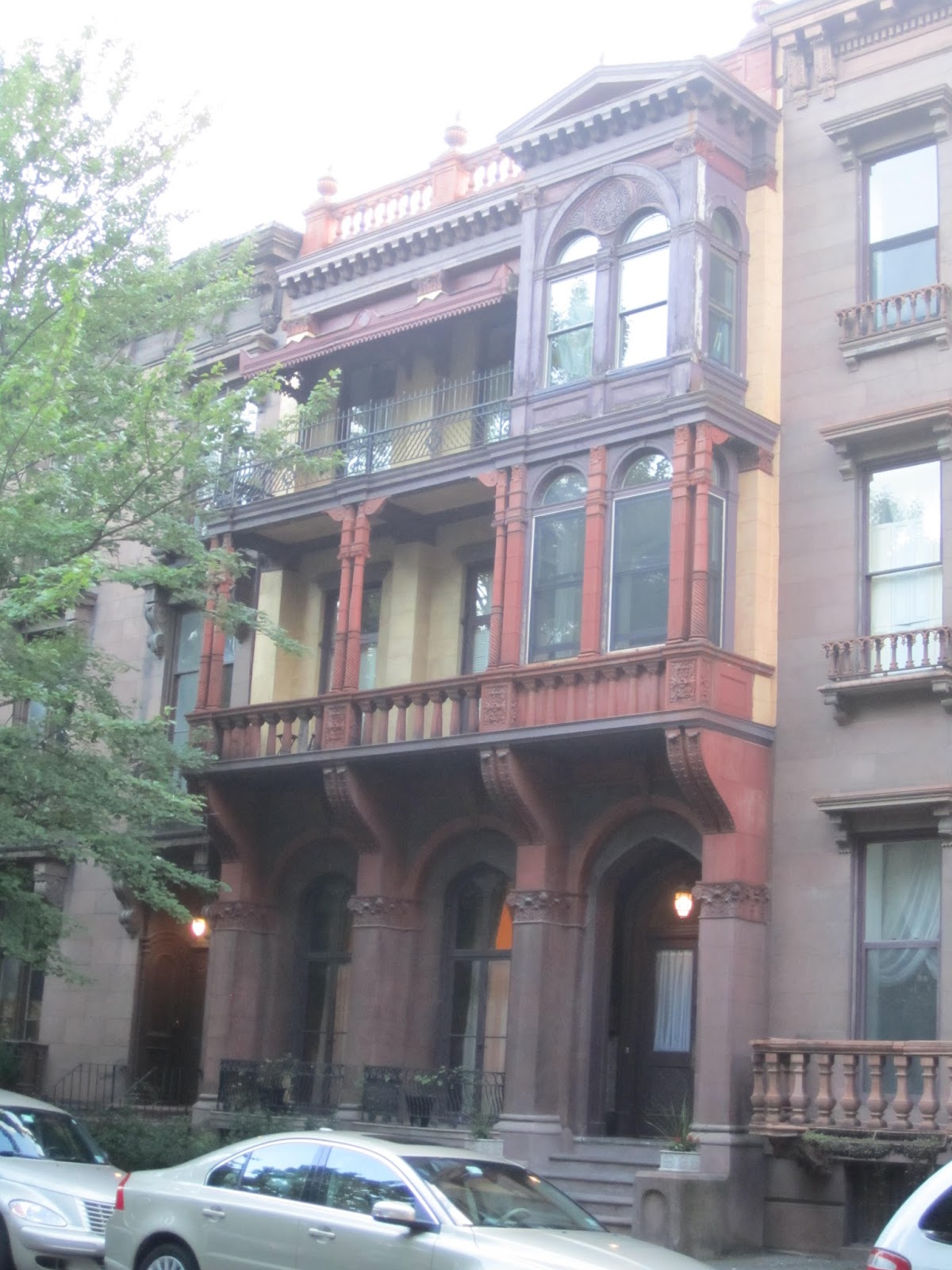
The Francis House, Troy, NY

The Francis House, Troy, NY. 1846.
This is perhaps the most fantastical house on the square. It was built for Hiram Slocum in 1846, but is named after the Francis family who purchased it in 1866 and remodeled the front in the 1880s. The remodel, or remuddle, no doubt altered what was a typical brownstone, Anglo-Italianate, row house plan structure into a cascade of balconies, overhangs, and an impressive Italianate box window. The pilasters on the first floor suggest there may have originally been pilasters supporting three arched openings with molded surrounds. The second floor probably had a box window with simple surrounds. It's been said the Francis family traveled frequently to Europe, and this might explain their desire to jazz up the house and make it even more Italian with multiple balconies, made of thin columns and an impressive metal, fringed awning. I particularly like how nicely handled the third floor box window is with its Venetian tracery, close packed brackets, and delicate metalwork appliques. The balustrade at the top completes the house's European pretentions.

Saturday, February 27, 2016

The Charles J. Saxe House, Troy, NY

Charles J. Saxe House, Troy, NY. 1854
At 193 2nd Street we find a house built for the Main family in 1854 but named for Charles J. Saxe, a lumber dealer. Like the Fuller house, this one also follows roughly the row house plan, but it lacks a bay, being extremely narrow. The bays are also not proportional and the left hand bay is much wider than the right, a feature we have seen on other houses on the park. The façade is brownstone and the windows lack typical moldings. Instead, there are extremely heavy brackets supporting moldings and iron balconies. This relieves the plainness of the façade and creates a rhythmic tension, preventing aggressive plainness. The cornice is very simple with only a pierced architrave molding and s scroll brackets.

Thursday, February 25, 2016

The Joseph Fuller House, Troy, NY

Joseph Fuller House, Troy, NY. 1853
Built in 1853 at 197 2nd Street for Hiram Ingalls, this brownstone row house is known for Joseph Fuller, a major stove manufacturer. The house is a variant of the row house plan in that it is three proportional bays with a fourth elongated bay to one side (very upstate). Sorry about the trees, this is a very verdant square. Again, we have simple molded segmental arched windows with intact iron balconies. The door is particularly interesting, since it is a rectangle when most doors have some kind of arch. The frame itself is arched and fitted into the opening. The narrow octagonal columns with wrapping moldings are borrowed from Gothic forms. The interiors with their lavish Eastlake and Renaissance Revival design are stunning and can be seen here. Would that I could post the pics of them here.

Tuesday, February 23, 2016

Washington Park: The Agnes Vaughan House, Troy, NY

The Agnes Vaughan House, Troy, NY. 1855
For the next series of posts (as I have found series of posts are best), I will be exploring the Washington Park historic district in Troy, NY. Troy is probably one of the country's architectural delights, not only because it has a nearly intact 19th century downtown with a music hall by George B. Post, but because it has Washington Park, one of the only private residential parks in the country. The streets along the park retain almost all of the original houses, of which the majority are fine, sophisticated, and very urban Italianates. The houses are well cared for and the owners knowledgeable and invested in their town, no doubt partially due to the Washington Park Association, to whom I owe a great debt for much of my historical information.

The park itself was established in 1840 when the property lots were divided, though the original lots were quickly resold. By 1860, most of the park was built up along its north (Washington St.), south (Washington Pl.), east (3rd St.), and west (2nd St.). Some of the houses are attached, but many are freestanding, although they follow general row house principles. While Italianate dominates stylistically, the ensemble is precious for having great examples of Gothic and Greek Revival as well. In general the other sides developed more quickly than the east. The inhabitants were upper middle class businessmen, factory owners, and merchants, and seemed to form a distinct social set. Although the area declined in the early 20th century and Troy itself began to decay drastically in the mid-20th century, it was revitalized in the 1960s and there was a renewed interest in Victorian design.

For my first house, I will be starting in the south-west corner. Built in 1855 at 199 2nd Street, it was inhabited by Agnes Vaughan from 1877 whose husband stole from his law firm and divorced her. Nonetheless, Agnes stayed in the house and eventually remarried. This house is one of my favorites. It follows a row house form, but has a central entrance, so one can call it symmetrical (without much of the centralized emphasis). The house's façade however is far from symmetrical, however, since the right hand bay is elongated, something one sees in many side hall houses in upstate NY, surely to accommodate a larger drawing room. The façade my be stuccoed or painted stone with corner quoins. The houses around the square are generally sparing in ornament, giving the whole a strong dignity and Anglo-Italianate flavor (shown also in the rusticated base); the segmental arched windows and door surround are simple moldings. It seems some iron balconies have been removed on the first floor. The windows feature interesting Venetian tracery wedged into a segmental arch, something that seems common in Troy. A projecting box window surmounts the entrance, another extremely common upstate NY feature; often these are the most ornamental parts of urban homes. The cornice is paneled with s scroll brackets. All in all a sophisticated design.

The southern part of the square has no Italianates proper. Rather the whole side is taken up by one long, unified Greek Revival row; however, the temptations of Italy seem to have won out over the Hellenic, since many of the houses feature Italianate doors and box windows. The survival of this row, once a common feature of 19th century cities, is truly impressive. It's pictured below.


Sunday, February 21, 2016

The R. A. Loveland House, Janesville, WI

The R. A. Loveland House, Janesville, WI. 1861 Photo: Sarah Lawver
The R. A, Loveland house was built in 1861 and is a smaller, cheaper version of the Lappin house posted two days ago. The house is another side hall plan, but has less features that emphasize centrality, confining itself to a central open pediment in the central bay and an arched window on the second floor. Otherwise, the house has basically the same porch with its paired columns and alternating round arched and filleted openings and similar Greek Revival eared moldings. Additional images can be found here. The cornice itself also lacks the sculptural qualities of the Lappin house with architrave moldings and simple brackets. The fascination of this house is how a similar plan and architectural treatment can manifest in different ways according to the wealth of the builder. There seem to be several example of this type in the city, and the design is clearly an important vernacular base for the town's Italianates.


Friday, February 19, 2016

The Thomas Lappin House, Janesville, WI

Thomas Lappin House, Janesville, WI. 1864 Photo: Sarah Lawver
The Thomas Lappin house in Janesville is a fine example of a side hall plan that oddly functions like a symmetrical plan, built in 1864 for a major early merchant in the town. It was designed by the architect Gary Nettleton, a local designer responsible for many Janesville houses. The house has several fine features; although the there is no central projection, symmetrical emphasis is achieved by an open pediment, a central arched window on the second floor, and a pediment on the central bay of the porch. This is in conflict with the side hall entrance. The house's details are dignified, with simple Greek revival eared window and door surrounds with crown moldings; the windows on the first floor are flat while the second floor alternates between rectangular, round, and segmental arched windows whose alternation makes a pleasing effect. There is an odd diamond window on the right side. The whole facade is outlined with verge boards at the corners. The porch is grand, fully bracketed with paired columns that alternately create arched and filleted openings. The cornice type, which seems common in Janesville, is heavily sculpted with paired c scroll brackets, secondary brackets, and dentils with a thick architrave molding, giving it a lot of weight. Additionally, the third floor windows are cleverly hidden within the cornice's sculpture with decorative grills. The architrave line is broken in the center to provide a further central emphasis. Unfortunately, it seems a second floor window has been replaced by a door and someone has stuck shutters around the central window that have been put on backwards (a personal pet peeve), but all in all, the house is mostly intact. Additional views can be found here.


Wednesday, February 17, 2016

The Brewster Randall House, Janesville, WI

The Brewster Randall House, Janesville, WI. 1862 Photo: Wikimedia
Photo: Wikimedia
This house is an example of remuddling at its most dramatic. It was built in 1862 for Brewster Randall, lawyer and senator, as a simple side hall Italianate with Greek Revival eared window surrounds and a rather fussy molded door surround, reminiscent of Federal designs. The greatest amount of ornament was confined to the fine cornice, with its attractive c scroll brackets with beads and acanthus leaves, that interrupt both dentils and s scroll brackets rotated under the very wide eave. A view of the house as it was can in 2003 be seen here. At some point, someone decided to have some fun. The visionary decided to add some Gothic style exterior lambrequins to the windows, added somewhat incongruous classical pediments over the windows, glued sculpted lions onto the door, and added an oversize classical balustrade to the door's cornice. Additionally, the simple lattice porch was enlivened with further Gothic and ovoid tracery. However, even though this is unquestionably a remuddle, it is surprisingly consistent with the Victorian innovative spirit and love of ornament. As we have seen in Janesville, there is a strong drive toward the eclectic syncretism of styles, as in the Tallman house. The redesigner's combination of Gothic, Classical, and Rococo forms onto an otherwise staid Italianate house could have been done in the 19th century as much as in the 20th. Although sometimes we value the perfection of style and bemoan later additions, for people in the 19th century a house was something to personalize, to constantly reinvent. They didn't think of their homes as museum specimens and felt no shame at adding a Queen Anne porch or a Second Empire turret to an Italianate cube. Italianate is an interesting style precisely because you can apply any sort of style to it. Thus, although this house may not be the perfect specimen of Italianate purity, it is a perfect example of the restless spirit of Victorian architectural innovation.