Showing posts with label Dayton Street District. Show all posts

Sunday, March 15, 2015

Summing Up Dayton Street

John Smith Photography See other posts for photo credits.
Although there are many more houses on Dayton Street that I could discuss, the 11 I single out offer a nice picture of characteristics that predominated on this street in the late 1860s and early 1870s. Because almost all the Italianate homes on the street were built in one go around the same time, it offers us a great snapshot of what appealed to wealthy Cincinnatians in the 1870s. A few characteristics can be singled out that broadly apply to the style of Anglo-Italianate that predominated here. While Anglo-Italianate design is found in some American cities, it is rarely found in the country. It seems that this kind of subdued, stone, Renaissance inspired style was an important indicator of wealth and taste in 19th century urban America, and set its adherents aside from those constructing more individualistic and less subdued houses. Dayton Street closely resembles in its aesthetics other neighborhoods in the country, such as Mount Vernon in Baltimore, parts of College Hill in Providence, and Brooklyn Heights in New York. While wealthy districts of Anglo-Italianate homes only seem to flourish in large cities as an expression of wealth; the like is rarely found in the country. Dayton street, like these other neighborhoods, displays a uniform set of characteristics that reflects the competition and influence home construction by the wealthy could have on others building in the same place. This list shows some features one can see consistently:

1. A mostly uniform cornice line, set at two and a half stories, as can be seen in the image above. While the cornices themselves display a wide variety of forms, brackets tend to be smaller and closely spaced, while entablatures are simple and mostly paneled. When windows enter into the design, they tend to elongate the brackets to make a strong frame for the window.

2. There is a strong horizontal emphasis provided by heavy string course moldings that clearly divide floors. Additionally, windows may be connected with horizontal moldings bands. Vertical emphasis is achieved by the framing of the facade and its elements with pilasters, quoins, and changes in volume to create complexity in an otherwise simple facade.


3. The favored material is primarily stone rather than cheaper brick. The use of stone allows the houses to have a more European and wealthy feel to them. Sometimes the stone is rusticated to delineate floors. Side walls of these houses are unimportant, and therefore the ornament and stone stop on the sides.


4. Ornament is not overwrought. Primarily, it consists of heavy, thick moldings, carved panels, and paneled keystones. The one elaborate feature is vegetal and rococo carving, an expensive mode of ornamentation whose use demonstrated the builder's wealth. This carving, however, is confined to specific architectural areas, window crests, panels, doors, and cornices.


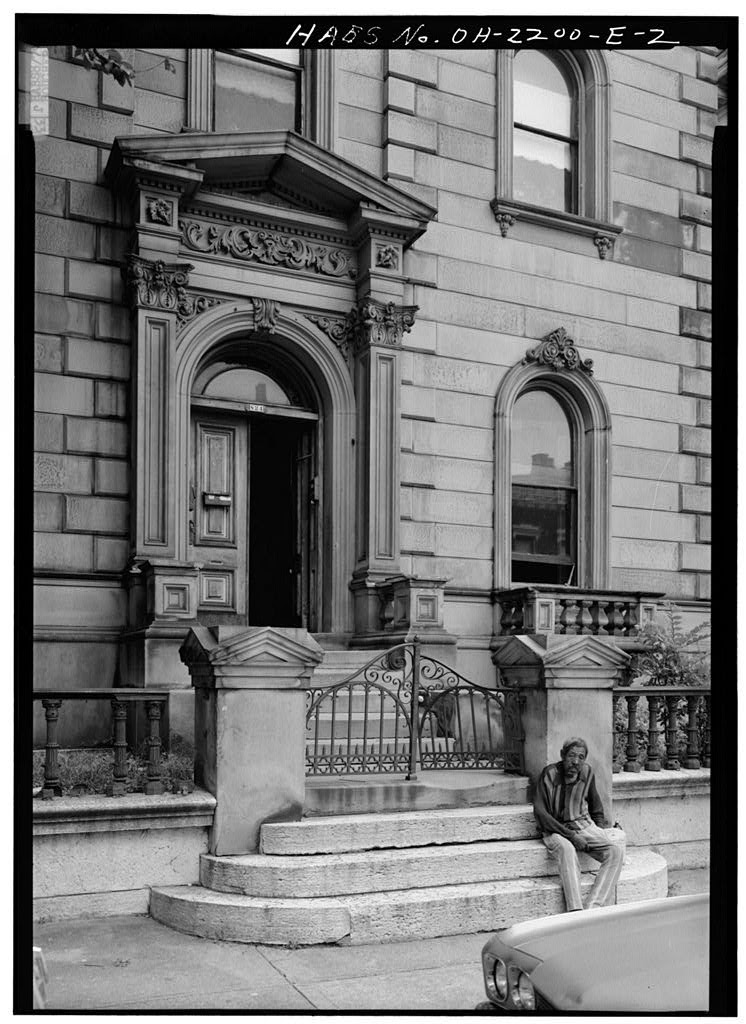
5. The favored shapes for windows and doors are overwhelmingly arches. Houses often have a combination of round arched and segmental arched windows. Door surrounds are typically fancy, with several houses having an engaged arched surround:


6. House plans tend to be either symmetrical or rowhouse types.


7. Finally, there is a uniformity achieved by fencing to the street. The connected stone retaining walls and newel posts framing the iron fencing gives the street a connecting base that connects all the houses. Similarly, balconies of either iron or stone create variation in the streetscape.

All in all, Dayton Street provides a textbook example of unified Anglo-Italianate design in America. Other neighborhoods of a similar character could be analyzed in a similar way, and, although there would be regional variations depending on local taste, nonetheless, a house in Cincinnati, Baltimore, or New York would resemble others elsewhere. Despite not being a common style throughout the country, the Anglo-Italianate idiom shared common features that connected it and wealthy families, with their like around the urban landscape of the 1860s and 1870s.

Friday, March 13, 2015

The John Kelley House, Cincinnati, OH

Kelley House, Cincinnati, OH. 1870s. Photo: Christie
Remaining Photos: HABS
The John Kelley house was built sometime in the late 1860s early 1870s (likely the 1870s when the rest of the street materialized). Little is known about the man it was built for, but like other houses on the street, it has the same Anglo-Italianate flair. The simple limestone facade of this rowhouse plan is not broken up into courses, and unlike most of the houses on the street, it has a Corinthian columned porch. The first floor has round arched windows while the second features segmental arches, a variation common to many houses on the street. The surrounds are the same on each window, with strong Renaissance acanthus leaf brackets and a molding. Spandrels are carved with the usual Renaissance vegetal designs. Uniquely on this house, the cornice has been elongated. Although it is of the bull's eye type, the windows are semicircular rather than round. The addition of the stone course with panels and incised carvings makes it seem much bigger than on other houses. All in all, this house has one of the finer and more finished facades on the street.


Wednesday, March 11, 2015

The Ferdinand Karrmann House, Cincinnati, OH

Karrmann House, Cincinnati, OH. 1870s John Smit Photography
Photos: HABS
The Ferdinand Karmann house, named after one of its most notable occupants, was built in the early 1870s on Dayton Street, and it is notable among the other houses because it is a full three stories tall instead of the typical two and a half stories. It thus breaks the mostly uniform height of the streetscape. The house, which has the typical rowhouse plan displays some of the Anglo-Italianate features of other houses on the street. The limestone facade's first floor especially with its simple arched windows with thick moldings and the door surround with the engaged arch, brackets, and pilasters echoes the Hauck house and most of the other buildings on the street. The second and third floors are a bit freer with their design, featuring segmental arched windows with eared moldings, strong paneled string courses, and projecting pilasters framing each floor. The frieze that runs between the window moldings with incised carving is interesting in that it creates the effect of having pilaster capitals. The cornice is simple with carved brackets and dentils. The house is currently a church.


Monday, March 9, 2015

The Chauncey Murch House, Cincinnati, OH

The Murch House, Cincinnati, OH. 1860s John Smith Photography
Other Photos: HABS
The Chauncey Murch house is another of the fine Anglo-Italianate homes on Dayton Street built sometime before 1868. The house is in line with the other limestone Italianates on the street, following the rowhouse plan. This house is notable for its rustication on both the first and second floors, increasing the horizontal flow of the house. It's not the amount of ornament in this house, but its careful application. The windows are all round headed; on the first floor simple moldings and keystones embellish them, while on the second, they are set in rectangular surrounds with moldings on top and simple carved spandrels. The decoration of the balcony (whose underside is even carved!) above the porch is particularly impressive. The thickly carved acanthus leaf brackets surround the arch which has a plaque in the center with leaves pouring into the spandrels. The balcony above is also of stone and displays the traditional oval and circle French balustrade design. The cornice is particularly elaborate. Little of the entablature can be seen because of the large windows that punctuate it. The brackets themselves are thick and paired, with a dentil molding in the center of each bracket and smaller brackets between. This makes the cornice seem rather ponderous, but nonetheless, this is in line with other houses in Cincinnati, with their overwhelming cornices. Inside, the interiors have all the elegance one would expect, although there is an odd arch in the parlor with a segmental arch enclosing a round arch.


Thursday, March 5, 2015

The James Laws House, Cincinnati, OH

The James Laws House, Cincinnati, OH. 1860s. John Smith Photography
Photos: HABS
The James Laws house, built in the 1860s (many dates for the houses on Dayton street are unclear because of a fire that destroyed records) is an interesting brick house on a street of limestone mansions. James Laws' daughters were particularly famous as spinsters who established kindergartens and nursing schools. Planwise, the house is difficult to classify. One could call it a rowhouse with a short wing on the side, however, in looking at the volumes and fenestration, I might say that it's actually an irregular plan house in which the facade has been completely flattened and all the recesses and projections have been flattened out with the tower removed. Regardless, the house displays many Anglo-Italianate features in its simple design. The facade is brick with limestone trim, including quoins at the corners, a Renaissance limestone entablature, and rafter brackets that are closely spaced, suggesting dentils. The windows are segmental arched and have a rectangular surround with a simple strip of molding at the top. The main door is round arched with a molding that has carved floral "capitals" and a curved keystone. Simple and spare, the house is a model design on the street.


Tuesday, March 3, 2015

The Elizabeth Howell House and the Thomas Gaussen House, Cincinnati, OH

Howell House, Cincinnati, OH. 1870s. Photos: HABS

Photo: John Smith Photography
Both of these rowhouse plan houses are emblematic of the more simple facades that can be found on Dayton Street.

This house (842 Dayton) was built in the late 1870s by Elizabeth Howell, although it is often known for being owned later by Louis Hauck. The design is very simple with round arched windows on the first floor and segmental arched windows on the second. The really interesting part is the entrance, which has heavy rusticated quoins surrounding the arched door. The play with rustication (exaggerating the joins between blocks of stone) is found in the over-sized voussoirs over the first floor windows. The brackets in this house are very strange, basically blocks of wood with finials that create a kind of fringe effect rather than a strong bracket division of cornice. The rustication is a feature especially found in Anglo-Italianate design, and the door, in some ways, resembles Federal designs.


Gaussen House, Cincinnati, OH. 1868. Photo: HABS
 This house (808 Dayton) was built by Elijah Meering and sold immediately to Louis Gaussen, a gas stove merchant in 1868. At the head of the avenue, it is a plain design that belies the elaborate facades along the street. With a plain facade, punctuated by round headed windows, the Gaussen house has a sort of quiet elegance. The simple window moldings have decorated keystones, and a Greek anthemion stands over the door with its neo-Grec pilasters. The cornice is paneled with oval windows. These two houses show the average design of Cincinnati Italianates. The style as its most commonly found in the city is just like the Gaussen house, with a touch of neo-Grec, simple molding on the windows, and a lot of emphasis on the elaborate cornice.


Sunday, March 1, 2015

The George Hatch House, Cincinnati, OH

The George Hatch House, Cincinnati, OH. 1850 Color photos: Wikimedia


The George Hatch house is much earlier than other houses we have seen on Dayton Street. It was built in 1850-1 for Hatch, a mayor, land speculator, and soap manufacturer, and was designed by Isaiah Rogers, who was responsible for the Gaff House in Indiana. Like the Gaff house, it has similarities to Greek Revival design, but remains a firm example of Anglo-Italianate architecture. Although the plan is symmetrical, the limestone facade undulates boldly. The bowed bays are particularly characteristic of Rogers and can be seen in his work on Boston's Tremont House. The central section maintains the facade's restlessness with its bayed entrance porch surmounted by a bay window. In terms of ornamentation, there is a very low amount on most of the facade. The bows have very plain windows with a minimum of molding. A broad string course separates the floors, but is enlivened by paired Temple of the Winds pilasters at the ends of the facade. The porch is truly lovely. Although it looks like a three bay projection, it actually forms a hexagon because the projection is reflected by a three bay recess in the facade. Corinthian columns alternate with Temple of the Winds pilasters. Above, the simple bay window has round windows which very thin, almost Federal Corinthian pillars. The Greek Revival cornice is ornamented with simple rafter brackets, suitable for the 1850s. Notably, this house has an octagonal cupola and a port cochere with a room above.

The interiors of the house are particularly impressive because of the massive staircase hall which is entered through the port cochere. Additionally, the floors are inlaid and tiled and the interior arches have Corinthian columns. The house has been recently restored.

The following images are from HABS.


Friday, February 27, 2015

The Allan Gazlay House, Cincinnati, OH

The Gazlay House, Cincinnati, OH Late 1860s Photo: Christie

Photo: John S
The Allen Gazlay House was built in the late 1860s for a wealthy property owner and investor on Dayton Street, and it is probably one of the best examples of Anglo-Italianate in the area. It is symmetrical in plan with the side bays slightly projecting and the limestone facade is defined by quoins. The windows are simpler than in other houses on Dayton, with all of them arched with a thick molding and rococo details at the top. On the first floor, there are Renaissance stone balconies. The most exciting feature is the extremely elaborate Renaissance door surround, which has Corinthian pilasters supporting a full entablature that is deeply carved and a triangular pediment. The round arched door is surrounded by a molding with more vegetal carving in the spandrels. Carving continues on the bracketless cornice which has a deeply carved vegetal frieze and dentils. Rare for houses on this street, the side facades, although plain brick, have some limestone details around the windows. The house seems to have taken all its decorative inspiration from the Renaissance and makes for a design that looks much more like the 1880s Renaissance revival than 1860s Italianate. The grandeur is carried over to the fencing, which has pedimented newel posts around the entrance.
Images below are from HABS, including a couple of the interior.